


A-to-Z Guide to HR Department Digitalization
Imagine a Monday morning when the CEO assigns you a task: “This year, the company must digitalize the HR department. Please coordinate with the IT department to research and implement it.”
Many HR Managers (HRM) begin the project by watching software demos and requesting quotations. In reality, a serious digitalization project does not start with software.
It starts with the enterprise clearly identifying which processes need to change, what data must be governed, who has authority, and what legal evidence must be retained.
In the article below, Quantera provides a comprehensive blueprint to help enterprises assess their current state and implement digitalization systematically.
1. HR digitalization is not simply “scanning documents”
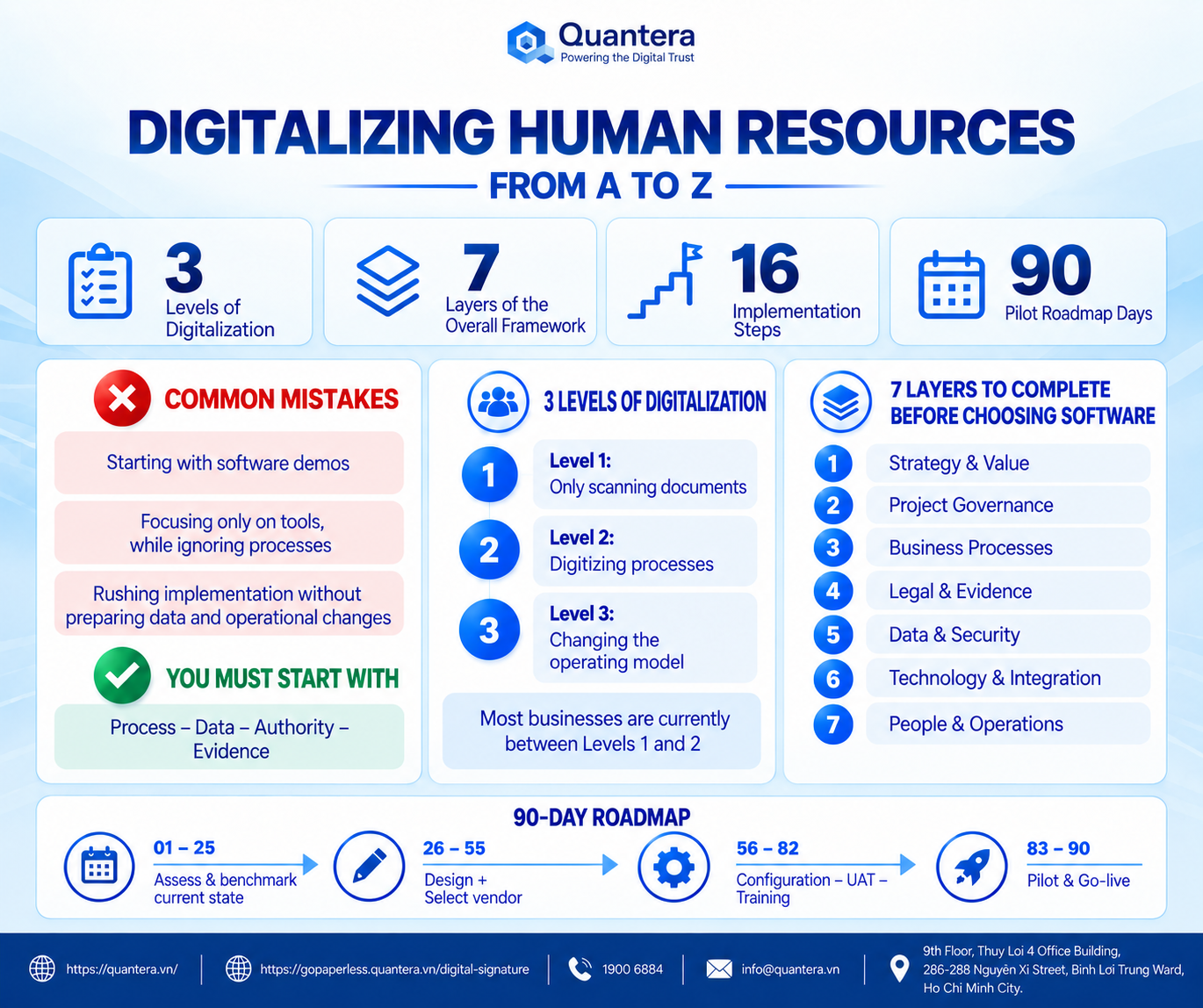
Before implementation, enterprises need to clearly determine which of the following three levels they are aiming for:
Level 1 – Convert documents into files: Scan contracts into PDF files and store them on Drive. The enterprise reduces paper usage, but files still have to be sent via Zalo, approvals are still tracked through messages, and data must still be re-entered manually. This is not yet process digitalization.
Level 2 – Move processes onto the system: Employees complete electronic forms; records are automatically routed to HR and Accounting; the system sends deadline reminders and enables digital signing.
Level 3 – Transform operations: Data is entered only once and flows seamlessly across the HRM, ERP, and eContract platforms. Access rights are automatically assigned based on job roles, while management can measure operational bottlenecks in real time.
Scanning documents into PDF files and storing them on Drive does not automatically create an electronic process capable of version control, action traceability, and complete retention of transaction evidence.
Therefore, enterprises need to clearly distinguish document digitization from end-to-end business process digitalization.
2. Defining responsibilities in an HR digitalization project
A successful HR digitalization project requires cross-functional collaboration and clearly defined responsibilities (RACI).
Core principle: IT does not decide HR processes; HR does not independently decide the security architecture; and the vendor does not determine internal authority on behalf of the enterprise.
HR Manager: Acts as the Business Owner. Responsible for defining processes, forms, and data, establishing the access control matrix, and planning organizational change.
IT & Security: Responsible for system architecture, system integration, account management, information security risk analysis, and data backup configuration.
Legal: Reviews the legal validity of electronic records, determines signing authority, finalizes electronic transaction regulations, and assesses contractual obligations with the vendor.
3. A 90-day A-to-Z roadmap for HR department digitalization
Instead of launching a large-scale implementation without clear direction, enterprises should apply a 90-day roadmap to a controlled pilot scope.
Phase 1: Measure the current state and design the process (Days 1 – 40)
- Secure an executive sponsor from the Board of Management to provide the authority required for implementation.
- Inventory all processes and records. Select 20 actual record sets and trace their processing journey backward to measure the Baseline (processing time, waiting time, and error rate).
- Design the target process so that data is entered only once, with a clear separation between internal approval actions and legally binding digital signature actions.
The output of this phase should not be a software demo. It should be a complete set of documents that enables the enterprise to answer: Which process will be piloted? How much time does the current process take? How does the enterprise want it to operate after digitalization?
Phase 2: Review legal requirements, access control, and select a vendor (Days 41 – 72)
- Create a Data Processing Inventory and establish an Access Control Matrix to comply with personal data protection requirements.
- Evaluate vendors based on security capabilities, ability to provide evidence, legal compliance, and Total Cost of Ownership.
- Sign the contract, configure the system, perform integrations, and cleanse master data before uploading it to the platform.
The output of Phase 2 should include at minimum:
- RACI Matrix;
- Access Control Matrix;
- Standardized Data Catalog;
- Pilot process configuration;
- Integration List;
- System Acceptance Criteria.
An important principle: do not move an unstandardized process onto software, because the system would only automate the inefficiencies that already exist.
Phase 3: User testing and pilot operation (Days 73 – 90)
- Conduct User Acceptance Testing with real-world exception scenarios (incorrect data entry, incorrect signer, or an unavailable approver).
- Train employees by role group and officially launch the pilot before scaling across the enterprise.
Phase 3 output: A complete Pilot Assessment Report reflecting the system’s level of compliance with requirements, actual operational effectiveness, areas for optimization, and the basis for deciding whether to scale across the enterprise.
4. Corporate governance documents to prepare before digital transformation
Implementing software is not merely a technical installation; it is also the process of establishing internal legal and governance procedures. These procedures form a chain of documents that helps the enterprise demonstrate who authorized the implementation, who has signing authority, and whether the system has been formally accepted.
Enterprises should issue three important groups of documents:
Group A (Issued before vendor selection): Project Proposal, Project Approval Decision, Responsibility Matrix.
Group B (Finalized before configuration): Electronic Transaction Regulations, Signing Authority and Delegation Matrix, Personal Data Protection Policy.
Group C (Finalized before Go-live): Acceptance Minutes, Official Go-live Decision, Operational Transition Plan, and principles for parallel use or discontinuation of paper-based processes within each implementation scope.
Note: From an implementation governance perspective, the enterprise may consider issuing documents in paper form or using its existing valid digital signature system until the new regulations and system officially take effect.
5. How can the GoPaperless Solution orchestrate HR processes?
Within an enterprise technology architecture, the HRM system remains the core source for employee data management. In this model, the GoPaperless Solution is not merely a “place to put the signing button”; it serves as the central Orchestration Layer across the entire process:
- Collect data through smart forms and automatically generate documents from available Templates.
- Route workflows to the right people, tightly control SLAs, and manage document versions.
- Support the orchestration of identity verification, digital signing, timestamping, and other components required for implementation in accordance with Decree 337/2025/ND-CP.
- Support the creation and retention of electronic evidence (Audit Trail) for reconciliation, inspection, and audit purposes.
6. Frequently asked questions about HR digitalization
If an enterprise already has an HRM or ERP system, does it need to replace it?
Not necessarily. The HRM or ERP system can continue to serve as the core business data management system.
Depending on the implementation architecture, the digitalization platform can integrate with existing systems to receive data, orchestrate processes, perform digital signing, and synchronize results back, rather than forcing the enterprise to replace its entire existing system.
Can access to salary data, Citizen ID (CCCD) information, and personal data be restricted by role?
Yes. When designing the system, the enterprise should build an access control matrix based on roles, departments, record types, and data scope.
This is also why access rights should be designed during the implementation phase rather than configured only after the system has gone live.
Can the enterprise run a trial without disrupting the entire organization?
Yes. The enterprise should start with a controlled Pilot, selecting representative processes, departments, or user groups for testing.
The Pilot results will help assess operational effectiveness, identify issues, and refine the configuration before deciding whether to scale.
What evidence should the system retain for inspections, audits, or disputes?
In addition to the completed document, the enterprise should consider the ability to trace processing history, including action timestamps, the person performing each action, document status, signatures, timestamps, and related transaction data.
The ability to retain and retrieve this information should be included in the solution evaluation criteria from the outset.
What should an enterprise prepare so that a demo or trial accurately reflects real-world needs?
Instead of simply asking the vendor to demonstrate available features, the enterprise should prepare actual processes, real forms, role groups, an approval matrix, and several exception scenarios.
A good trial should demonstrate how the system solves the enterprise’s actual business problem, not merely how many features the software offers.
View 36 more frequently asked questions and answers about electronic labor contracts and GoPaperless to learn more about legal requirements, operations, data, and implementation options.
7. Conclusion: Where should HR digitalization begin?
HR digitalization does not begin on the day the enterprise signs a software purchase contract. It truly begins when management determines how a record will be created, who is authorized to act on it, how the data will be protected, and what evidence will remain after the work is completed.
Instead of digitalizing everything at once, following a 90-day implementation roadmap with careful preparation across processes, access control, data, and legal requirements is the key to successful digitalization, cost optimization, and a strong governance foundation.
To help the HR department begin implementation immediately without being overwhelmed by procedural requirements, we have prepared a practical set of essential implementation documents.
👉 [Download the HR Digitalization Implementation Template Pack for Free] (The pack includes: Documents to be issued before digitalization, documents to be finalized before digitalization, and documents to be finalized before Go-live).
👉 Need expert guidance? Join our Zalo Community [Digital Transformation Community for Businesses] to connect directly, get answers to your questions, and discuss challenges with experts, lawyers, and engineers from the Quantera ecosystem!
Community Discussion