


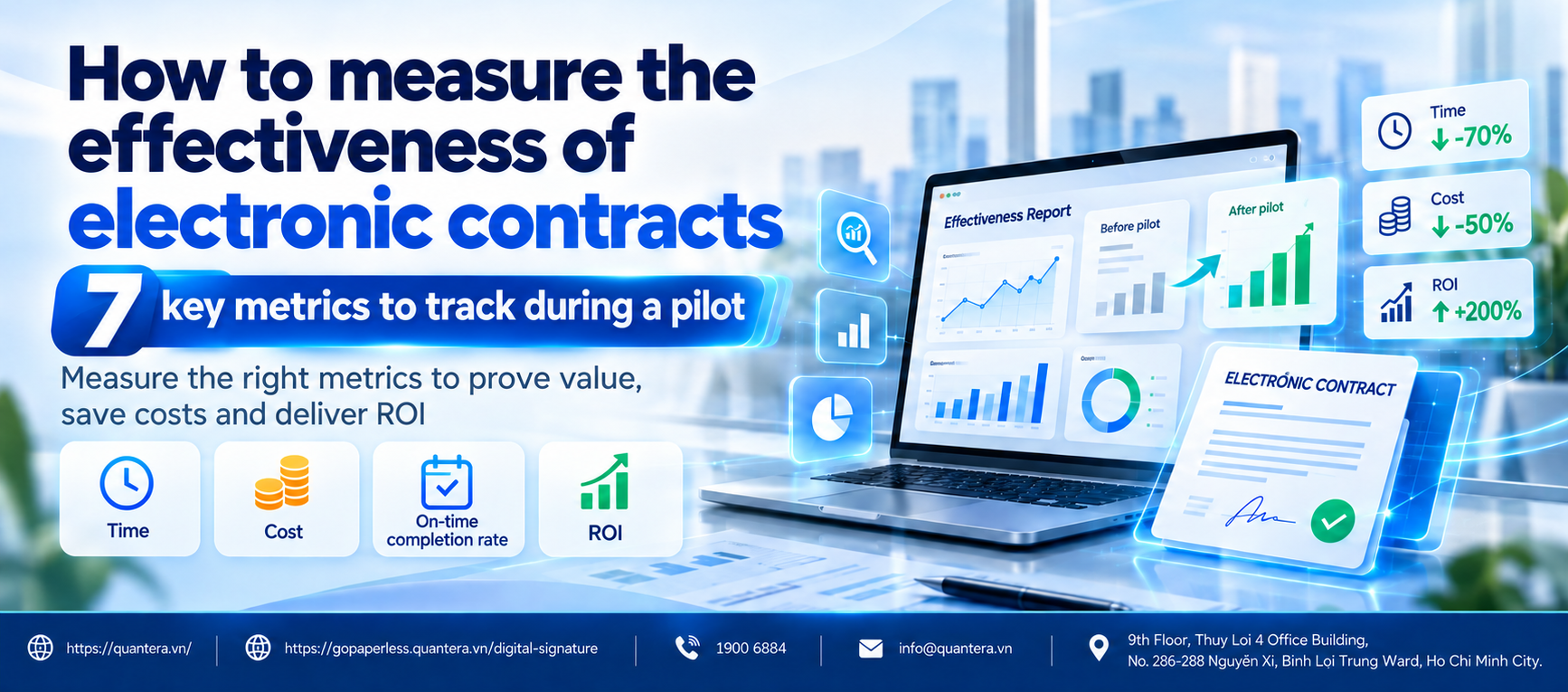
How to Measure Electronic Contract Effectiveness: 7 Metrics to Track During a Pilot
A business with around 300 employees decides to pilot electronic employment contracts with 30 new employees.
After one month, the result is very good: 30/30 contracts have been signed successfully.
HR assesses that the system is operating stably and proposes that the Board of Management approve the budget for official deployment.
But at this point, one question arises: “If we deploy it across the entire company, how much will the business actually save?”
30/30 contracts being signed successfully proves that the system can work. But this figure does not show how much faster the new process is, how much manual work HR has reduced, how the cost per contract has changed, or whether the on-time completion rate is actually better.
This is why businesses should determine how to measure electronic contract effectiveness before starting the pilot, rather than waiting until the end of the phase to look for data for a report.
In this article, Quantera will guide businesses through 7 metrics that should be measured before and during the pilot so that, after 30 days, effectiveness can be reported using data rather than perception.
1. Why Does a Successful Contract Signing Pilot Still Not Prove Effectiveness?

When piloting an electronic employment contract solution, businesses usually focus on questions such as:
- Did the employee receive the contract?
- Can the employee sign it?
- Can the enterprise representative sign it?
- Is the contract completed?
- Does the system have any errors?
These are all necessary questions. But they mainly prove the system’s ability to operate.
The Board of Management usually looks at the issue from a different layer:
- How much faster is the new process?
- How many hours can one HR employee save?
- How does the cost of one contract decrease?
- Does it reduce manual data entry?
- Does it reduce records that need to be corrected or redone?
- Does it reduce the time HR has to spend chasing signers?
- Does it help contracts get completed on time more often?
In other words: “Being able to sign” is a necessary condition. “Creating value” is the basis for making an investment decision.
This is also why, when implementing digital transformation, businesses should start from operational problems and the value that needs to be improved instead of only looking at technology features.
See the detailed analysis at: Top 5 Things Businesses Should Note When Implementing Digital Transformation.
2. Measure the Current Process Before Piloting Electronic Contracts
This is a step that is very easy to overlook.
A business starts a pilot, finds that the new process is faster and more convenient, but does not record how much time the old process used to take.
The final report can only say: “People feel that it is quite fast to use.”
To know how much the new process has improved, the business must have a baseline for comparison.
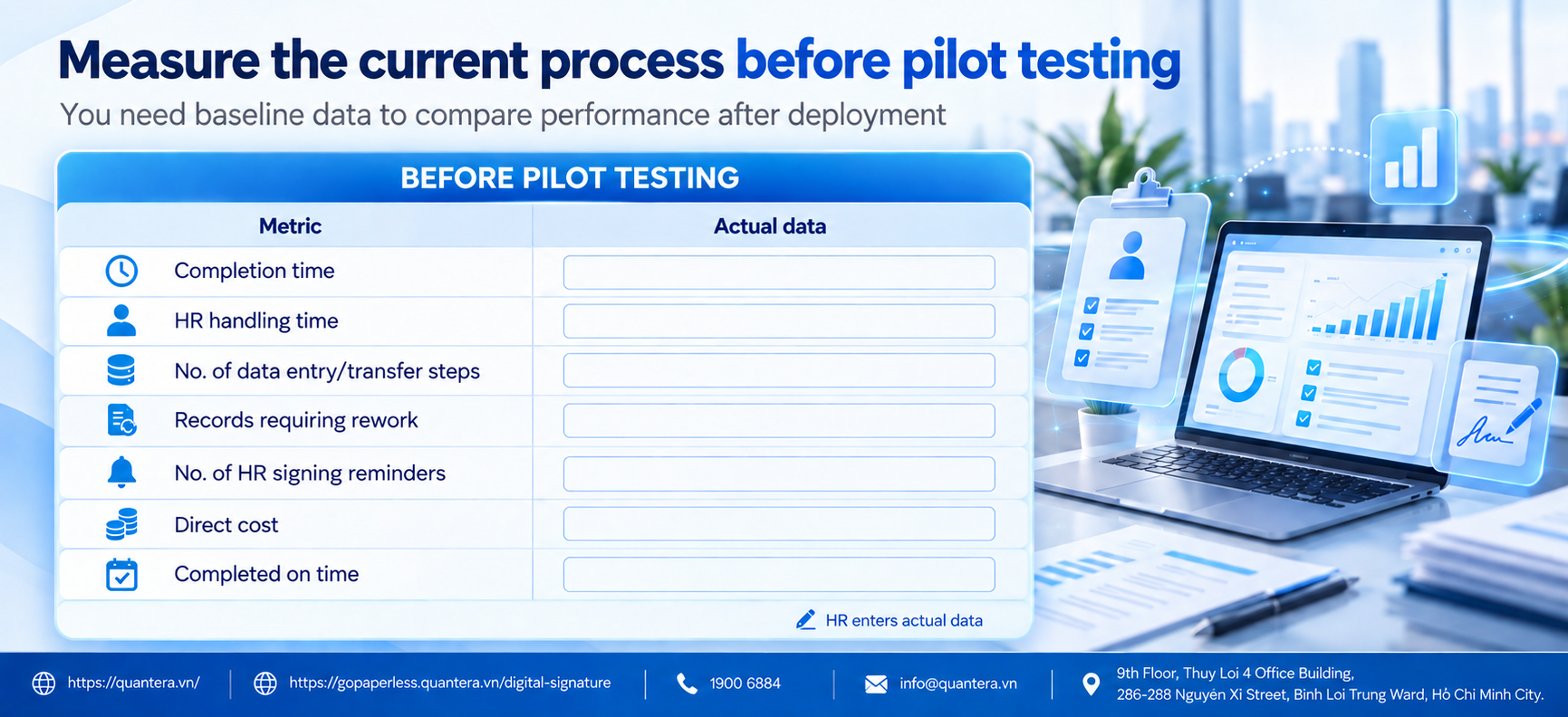
Before the pilot, select a sufficiently representative group of contracts and accurately measure the same metrics that will be measured in the new process.
Illustrative example:
| Metric | Current Process |
|---|---|
| Time to complete one contract | 2.5 days |
| Time HR directly spends on tasks | 25 minutes/contract |
| Number of manual data entry/transfer steps | 4 times/contract |
| Records requiring reprocessing | 12% |
| Number of times HR has to remind signers | 2 times/contract |
| Direct cost | VND 45,000/contract |
| Completed on time | 78% |
Note: The figures above are for illustration only. Businesses need to use their own actual data.
The important point is that, after the pilot, the business must remeasure exactly those same 7 metrics.
If the before and after periods use two different measurement methods, the results will not be reliable enough for comparison.
Without data from the old process, it is very difficult to prove how much better the new process really is.
3. 7 Metrics to Measure During an Electronic Contract Pilot
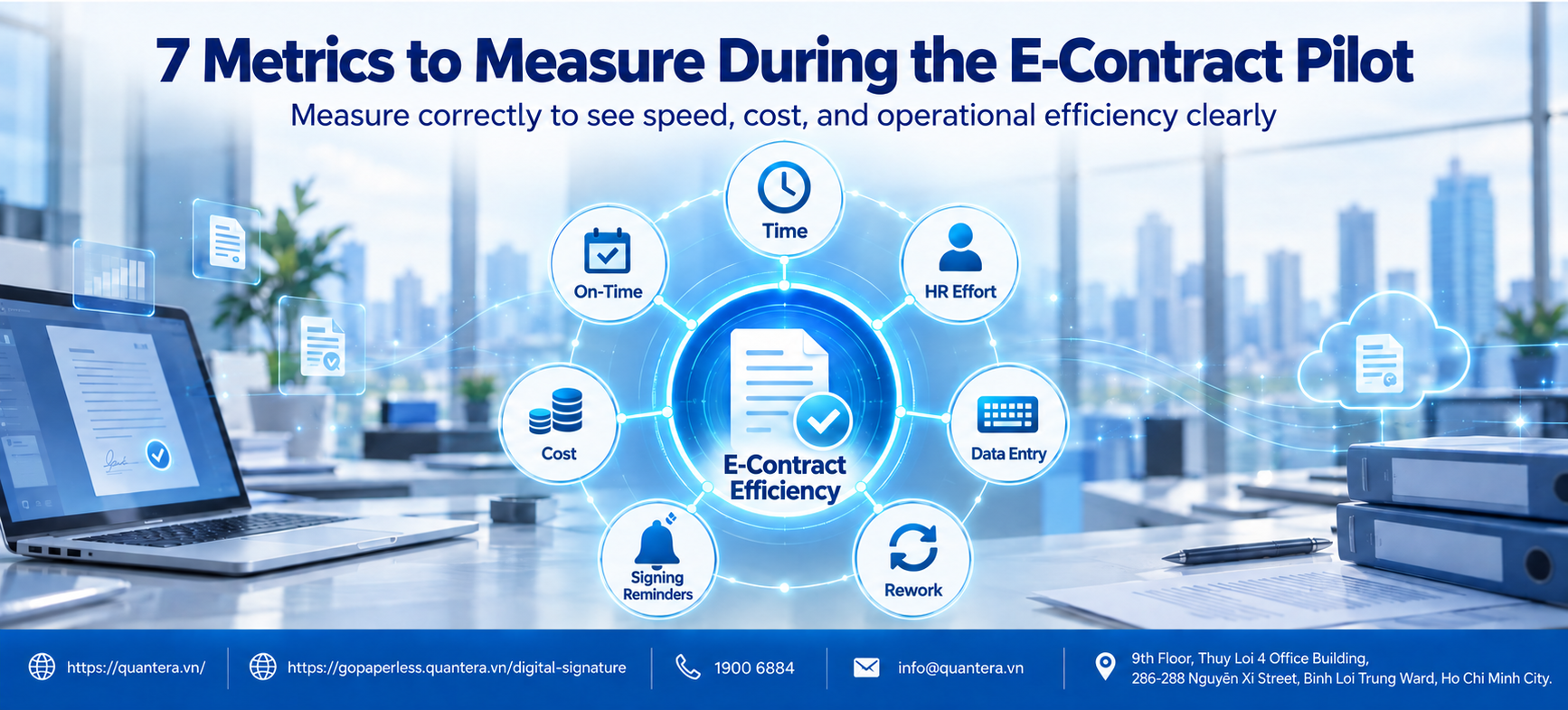
3.1. Time to Complete One Contract
This is the easiest metric to understand, but it is also very easy to measure incorrectly.
Do not only calculate: Employee opens the link → finishes signing.
The entire duration needs to be measured: HR starts preparing the contract → the contract is completed by all parties.
Illustrative example: Old process: 2.5 days/contract and after the pilot: 6 hours/contract
This allows the Board of Management to immediately see the impact of digitization on processing speed.
In addition to the average time, the business should also track the median or groups of unusually slow records and clearly record the reasons, rather than removing these cases from the results without predetermined criteria.
3.2. Time HR Actually Spends on Tasks
A contract may take two days to complete, while HR only spends 10 minutes actively working on it.
Conversely, a contract may be completed in one day, but HR has to continuously create files, send emails, check statuses, make phone calls, and update Excel.
Therefore, measure separately: How many minutes does HR actually have to spend on one contract?
The following tasks may be included:
- Retrieve data
- Draft or create the contract
- Check information
- Transfer the record
- Send it to the signer
- Check status
- Send signing reminders
- Scan
- Save the file
- Update the tracking sheet
Illustrative example:
If the business processes 5,000 transactions per year, this difference can be converted into a very specific number of working hours.
Simple formula:
HR hours saved/year = Time saved per contract × Number of contracts/year ÷ 60
17 minutes × 5,000 contracts ÷ 60 = approximately 1,417 working hours/year.
This figure is much more meaningful than the comment “HR finds it more convenient.”
3.3. Number of Times Data Must Be Entered or Transferred Manually
A process that has not been fully digitized may look like this:
HRM → Excel → Word → PDF → send for signing → tracking Excel.
The same personal data, such as full name, Citizen ID number, job title, etc., may be copied or re-entered many times.
Each re-entry creates two costs: time and the risk of incorrect data.
Therefore, the business needs to measure: How many times does one contract require people to manually copy, enter, or transfer data?
Example: Before: 4 times/contract – After: 1 time/contract
This metric is especially important when the project goal is not only electronic signing but also digitizing B2B approval workflows and reducing manual data-transfer steps.
3.4. Percentage of Records Requiring Intervention or Exception Handling
No process is completely free of exceptions.
For example, in a pilot of 30 contracts:
- 2 records contain incorrect information
- 1 record has to be withdrawn
- 1 employee refuses to sign
- 2 employees do not receive the signing notification
The business should not simply record: “There were 6 exception cases.”
Exception rate = Number of records requiring manual intervention / Total number of records × 100%
At the same time, also record: How many additional minutes does each exception case require?
Example: 30 contracts, with 3 contracts requiring intervention
Intervention rate: 3 / 30 × 100% = 10%
If each case takes an additional average of 15 minutes, the operating cost of exception handling also needs to be included in ROI.
This is why businesses should not pilot only “clean” records. Before broader deployment, they should proactively test cases involving incorrect data, refusal to sign, signer changes, or record resubmission to assess real-world operational capability.
3.5. Number of Times HR Has to Remind Signers
This is one of the “invisible” types of work that is easily left out of calculations.
The actual process may be: Open Excel → see who has not signed → send a Zalo message → send an email → make a phone call → check again the next day.
Each reminder only takes a few minutes, so it is often not counted.
But if the business has thousands of contracts, the total time is very large.
Measure: On average, how many times does HR need to proactively remind a signer for one contract?
Example: Before: 2.1 times/contract – After the pilot: 0.6 times/contract
If there are 5,000 contracts/year, a reduction of 1.5 reminders/contract is equivalent to 7,500 manual follow-up actions being eliminated or reduced.
This figure helps the Board of Management see work that previously rarely appeared in cost reports.
3.6. Actual Cost per Contract
If only paper and ink are counted, the business will underestimate the cost of the traditional process.
At a minimum, consider:
- Paper
- Ink
- Printing
- Envelopes
- Delivery
- Scanning
- Physical storage
- Staff handling time
- Follow-up time
- Cost of reprocessing incorrect records
Average cost/contract = Total processing cost / Total number of contracts
Illustrative example: Old process: VND 45,000/contract – Electronic process: VND 18,000/contract
Difference: VND 27,000/contract
If the business processes 5,000 contracts or transactions per year:
27,000 × 5,000 = VND 135 million/year
This is how the benefit of “reducing paperwork” becomes a figure that can be used in an investment decision.
3.7. Percentage of Contracts Completed on Time
Not every benefit can be converted directly into money.
For HR, one especially important metric is whether contracts are completed by the time required by the business process.
For example, the business may require employment contracts to be completed before the employee’s start date.
On-time completion rate = Number of contracts completed on time / Total number of contracts that must be completed × 100%
Illustrative example: Before: 78% – After the pilot: 95%
This difference directly reflects the operating capability of the HR department.
It also helps leadership see that the value of electronic employment contracts lies not only in cost reduction but also in the ability to control progress.
4. How Should ROI Be Calculated After the Pilot?
Once before-and-after data is available, the business can begin calculating financial effectiveness.
There is no need to build an overly complex model from the outset.
Note: All figures below are illustrative.
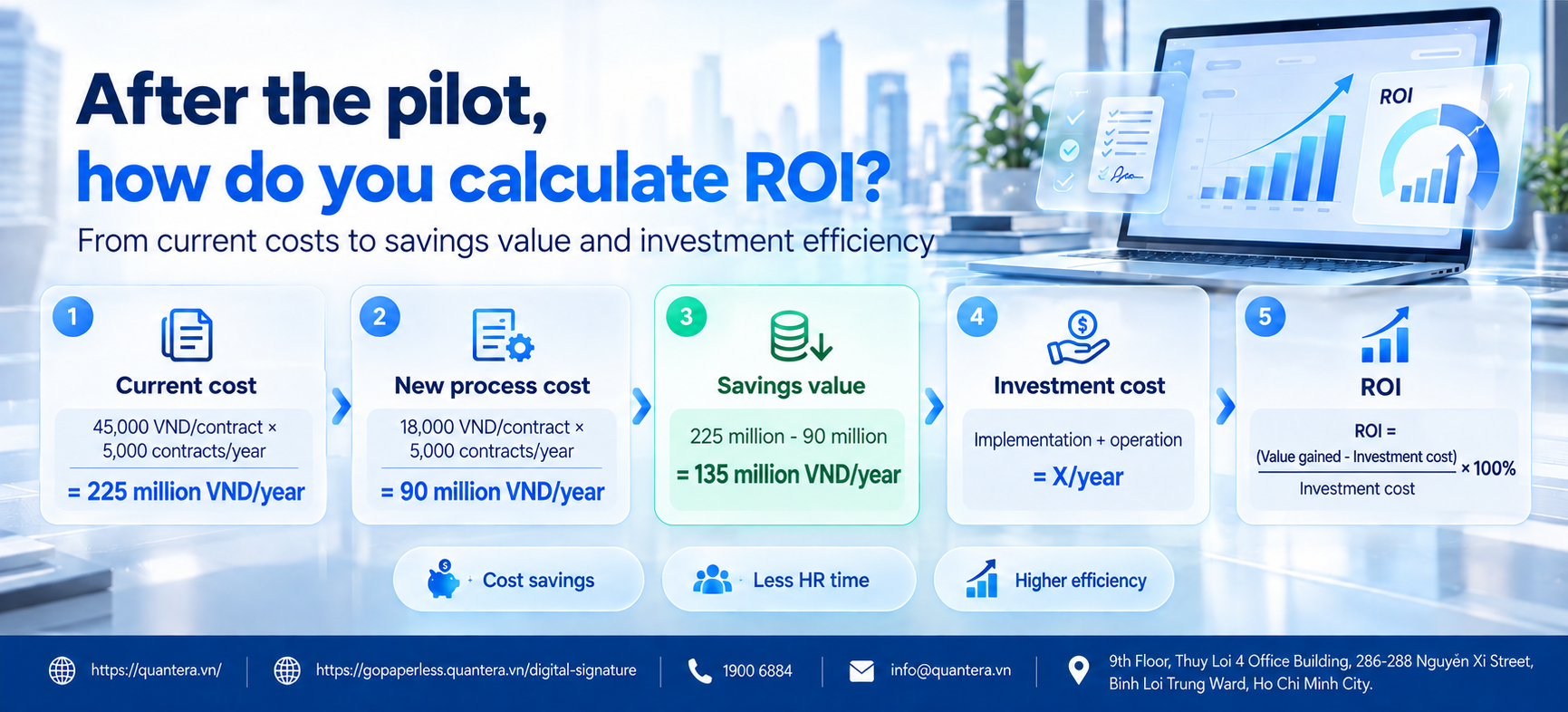
Step 1: Calculate the cost of the current process
VND 45,000/contract × 5,000 contracts/year = VND 225 million/year
Step 2: Calculate the cost of the electronic process
VND 18,000/contract × 5,000 contracts/year = VND 90 million/year
Step 3: Calculate the savings value
VND 225 million – VND 90 million = VND 135 million/year
Step 4: Compare with the investment
Assume the total cost of deploying and operating the solution is X VND/year. The business can use the formula:
ROI = (Value obtained – Investment cost) / Investment cost × 100%
However, the business should not present only one financial ROI figure.
A good report should also include:
- Cost savings
- HR working hours saved
- Reduction in completion time
- Reduction in manual actions
- Reduction in records requiring reprocessing
- Increase in on-time completion rate
Because some operational values are very important but difficult to convert completely into money.
Note when calculating ROI: Do not double-count benefits. If the processing cost per contract already includes HR time costs, the saved working hours should only be used to explain the source of the benefit and should not be added a second time to the total financial value.
5. How to Report Effectiveness to the Board of Management
Do not end the report with: “30/30 contracts were signed successfully and users gave positive feedback.”
Convert the data into a table that leadership can read in a few minutes.
Illustrative example:
| Metric | Before | After Pilot | Change |
|---|---|---|---|
| Completion time | 2.5 days | 6 hours | Decrease |
| HR handling time/contract | 25 minutes | 8 minutes | Decrease |
| Data entry/transfer | 4 times | 1 time | Decrease |
| Records requiring reprocessing | 12% | 5% | Decrease |
| HR signing reminders | 2.1 times | 0.6 times | Decrease |
| Cost/contract | VND 45,000 | VND 18,000 | Decrease |
| Completed on time | 78% | 95% | Increase |
After the table above, only three additional questions need to be answered:
- If applied to the full annual volume, how much value would be saved?
- What is the cost of official deployment?
- Beyond cost, which operational points would the business improve?
At this point, the conversation changes completely.
Instead of: “HR wants to buy new software.”
The proposal becomes: “This is an investment with before-and-after data and measurable operational impact.”
6. How Does GoPaperless Help Businesses Measure Effectiveness During the Pilot Phase?
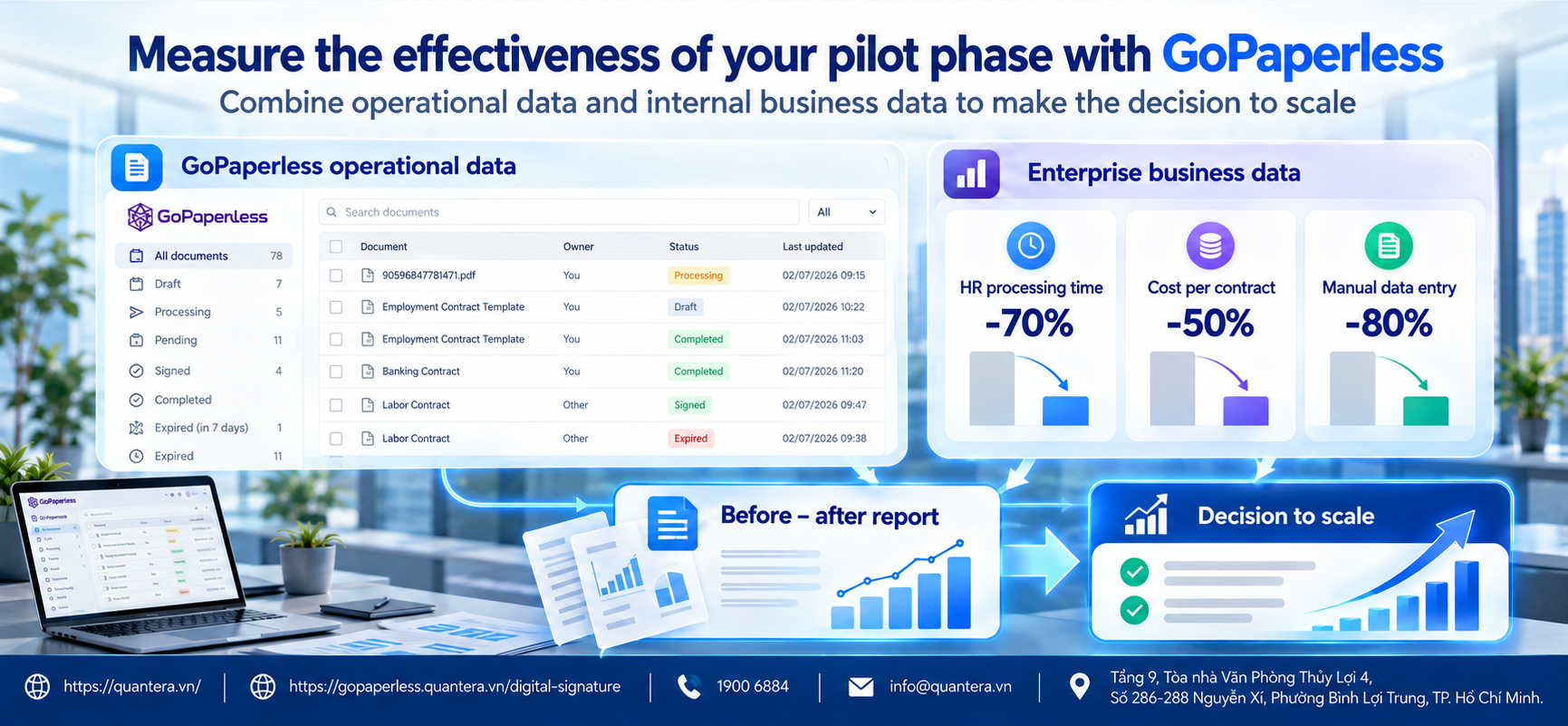
GoPaperless is a solution from Quantera that helps businesses manage the process of creating, sending, signing, and completing electronic records.
Through the status and processing history of each record, the business has a data basis for analyzing operational performance instead of relying only on user perception.
Businesses can learn about the overall solution at What Is GoPaperless? An Electronic Contract Digitization Solution Compliant with Decree 337.
During the pilot phase, workflow data can help the business identify milestones such as:
- Time the record was created
- Time it was sent
- Pending processing status
- Time the signing steps were performed
- Time the record was completed
- Records that remain incomplete or have exceptions
This data is especially useful for calculating completion time and tracking completion rates.
However, the system cannot automatically create the entire ROI report if the business does not prepare input data.
For example, to know how many minutes HR saves, the business still needs to measure HR handling time before and after.
To know how much money is saved, the business still needs to determine the costs of paper, delivery, storage, labor, and other actual expenses.
Therefore, the appropriate approach is to combine: Operating data on GoPaperless + business cost and labor data = Before-and-after effectiveness report.
Quantera accompanies the business throughout the pilot phase, from identifying the metrics to measure and agreeing on how to establish the baseline, through tracking results and consolidating data to support the decision on whether deployment should be expanded.
The objective is not to prove: “GoPaperless successfully signed 30 contracts.”
Instead, it is to help the business answer: “If applied to the next 3,000 or 30,000 contracts, what value will the business receive?”
See how the cost of one electronic contract is calculated: GoPaperless Pricing
7. Conclusion
A successful electronic contract pilot should not end with:
“30/30 contracts were signed successfully.”
The business also needs to know:
- How much faster the process is
- How much time HR saves
- How many manual actions are reduced
- How many records no longer need to be reprocessed
- How many signing reminders are reduced
- How much cost is saved
- How much the on-time completion rate increases
The approach is very simple:
- Before the pilot, measure the baseline.
- During the pilot, track the same 7 metrics.
- After the pilot, compare before and after.
- Finally, convert the results into financial and operational impact.
At that point, HR no longer has to present to the Board of Management by saying: “People find the system quite convenient.”
Instead, HR can say: “This is what the business is currently losing in the existing process, this is the result after the pilot, and this is the value that can be achieved if deployment is expanded.”
That is the real objective of a pilot phase before the business decides to invest.
Is your business preparing to pilot electronic contracts but unsure which data should be used as a baseline or how to calculate before-and-after effectiveness?
👉 Join the Q&A – Human Resources, Labor and Payroll Community now to discuss real implementation situations, ask questions about system integration, and work with the Quantera team to resolve challenges during digital transformation.
8. Frequently Asked Questions When Measuring Electronic Contract Effectiveness
Is It Mandatory to Measure All 7 Metrics?
No.
Businesses should prioritize the metrics linked to the project’s initial objectives.
If the main objective is cost reduction, focus on cost/contract, HR time, and manual actions.
If the current problem is that contracts are frequently delayed, prioritize completion time and the on-time completion rate.
However, using a consistent set of metrics helps the business avoid evaluating the project too heavily based on only one benefit.
How Many Records Should Be Used to Establish the Baseline?
There is no fixed number for every business.
The important point is that the group of records must be sufficiently representative of the actual process.
Do not select only simple contracts if, in real deployment, the business usually has many contract types, multiple business units, or multiple approval levels.
Is Electronic Contract ROI Only About Money Saved?
No.
Financial ROI is very important for investment decisions, but businesses should also report operational benefits such as:
- Reduced working hours
- Reduced data entry
- Reduced reprocessing
- Faster completion
- Higher on-time completion rate
These metrics help explain why costs or productivity change.
If the Pilot Is Successful but ROI Is Not Good, Should the Business Deploy?
A conclusion should not be made solely from the fact that the system runs successfully.
If effectiveness does not meet expectations, the business needs to review:
- Whether the old process was truly changed or merely converted into electronic form
- How many manual steps remain
- Whether the pilot scope is representative
- Whether users operated the process correctly
- Whether the initial expected benefits were realistic
A “ROI not yet achieved” result is still valuable data because it helps the business make adjustments before investing at scale.
What Else Should Be Considered for Electronic Employment Contracts Besides Operational Effectiveness?
For electronic employment contracts, effectiveness and ROI do not replace legal compliance requirements.
Businesses still need to design the execution and performance of electronic employment contracts in accordance with Decree No. 337/2025/ND-CP and the guidance in Circular No. 08/2026/TT-BNV .
Employees also need to clearly understand how to receive, review, and execute the contract.
Businesses can also refer to Guide to Signing Electronic Employment Contracts: 4 Easy Steps for Employees.
See 36 more frequently asked questions and answers about electronic employment contracts and GoPaperless to learn more about legal requirements, operations, data, and implementation options.
Community Discussion