


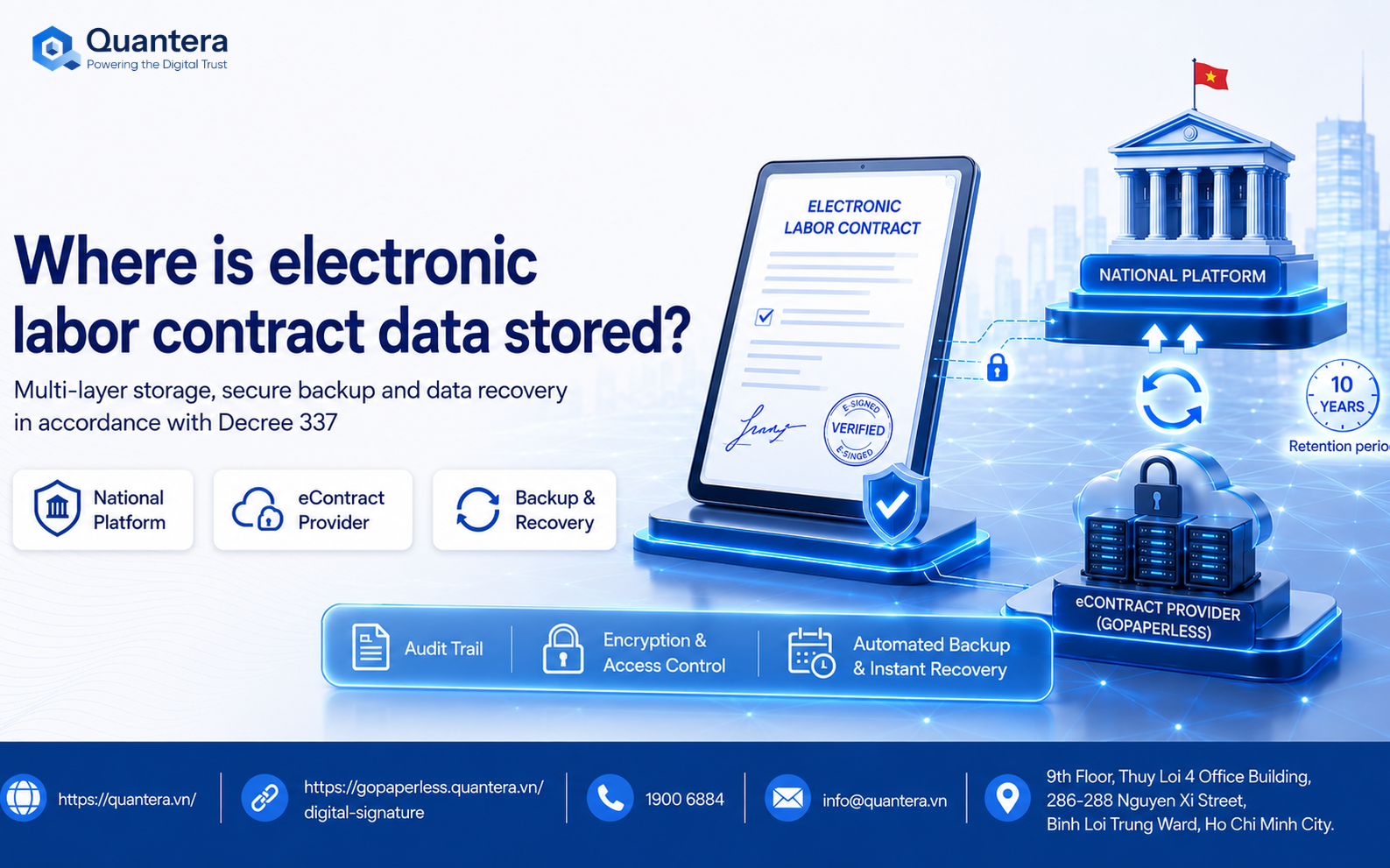
Where Is Electronic Employment Contract Data Stored?
When transitioning from traditional paper documents to a digital environment, one of the biggest concerns for business owners and HR departments is the security of digital assets: “Where is electronic employment contract data stored? If the system fails or the software provider ceases operations, could all the data be completely lost?”.
Based on the latest legal framework, particularly the 2025 Law on Digital Transformation and Decree No. 337/2025/ND-CP, enterprises’ digital assets are protected by an extremely stringent multi-layer mechanism. In this article, Quantera will explain in detail where data is stored, disaster recovery scenarios, and how enterprises can maintain complete control over their data.
1. Where Is Electronic Employment Contract Data Stored?
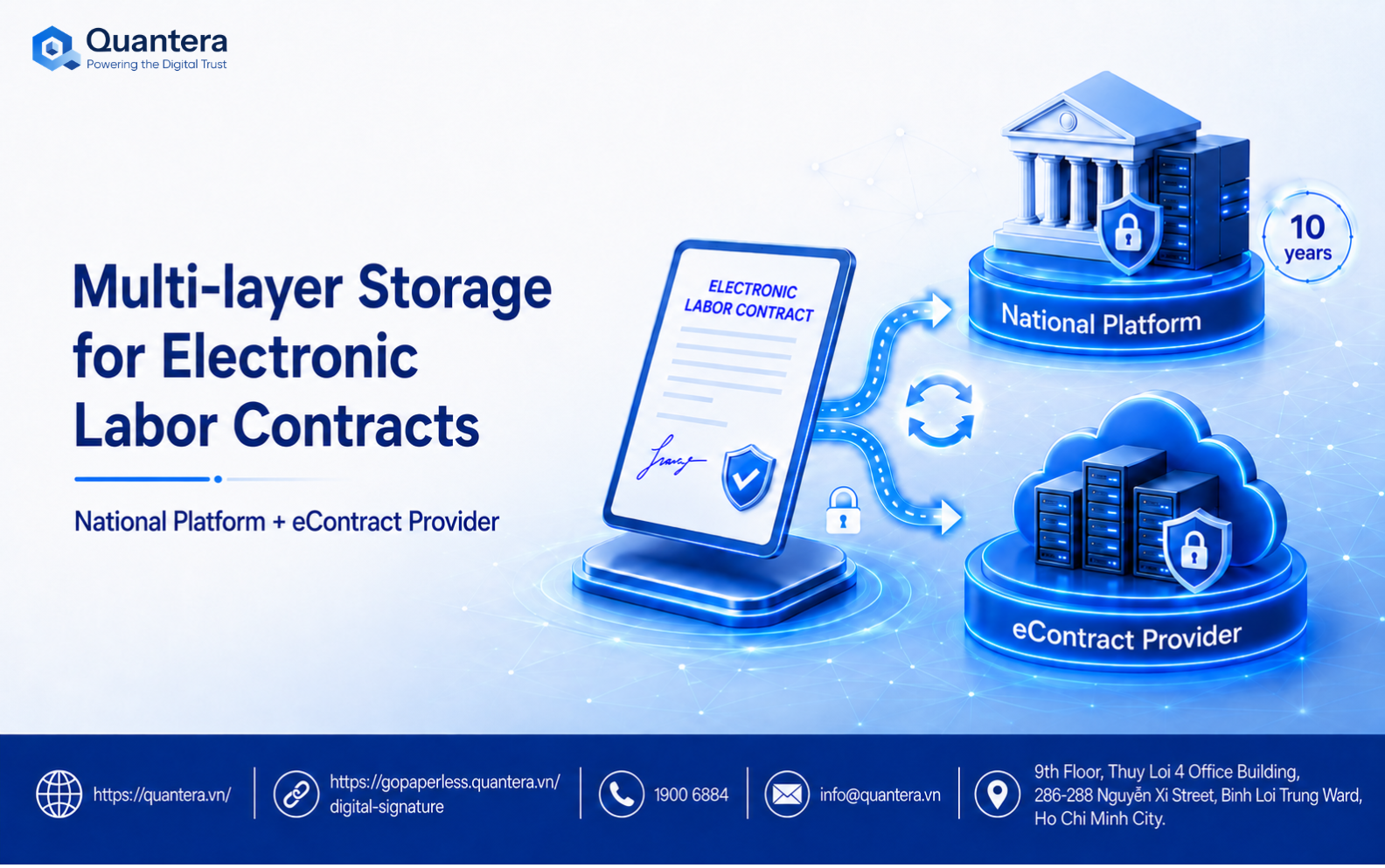
To absolutely ensure the legal validity of electronic employment contracts, current electronic employment contract regulations require data to be managed under a layered mechanism (multi-layer storage) across two main systems:
Centralized storage on the National Platform (Ministry of Home Affairs): Immediately after successful execution, contract data must be submitted to the National Electronic Employment Contract Platform. Physically, the entire infrastructure is operated on the foundation of the National Data Center. Notably, the retention period here is up to 10 years from the date the employment contract ceases to be effective, creating an absolutely secure original data repository maintained by the State.
Storage on the service provider’s system (eContract): In parallel with the State authority, electronic signing software providers (eContract providers) are responsible for storing and securing contract data on their own server systems. Once the National Platform approves the contract and issues a unique ID, this information is synchronized back to the provider’s system so that HR can easily perform internal lookups.
2. Data Backup and Recovery Mechanisms in the Event of an Incident
A platform that meets the standards for electronic employment contracts under Decree 337 not only requires secure storage but must also pass rigorous tests for risk resilience. Data protection scenarios prescribed by law include:
Preservation Mode: If a connection failure occurs or the service provider temporarily suspends its services, all validly executed contracts will immediately be placed into a “frozen” state. This mechanism strictly prohibits any modification or interference with the original transaction history in order to preserve intact technical evidence for court proceedings in the event of a dispute.
Infrastructure disaster recovery scenario: The digital system is required to have a plan to isolate affected areas in the event of a cyberattack. After the incident is resolved, the data must be fully restored from pre-established backups, ensuring 24/7 information availability.
Protection against “orphaned data” when a provider is dissolved: Enterprises do not need to worry about losing their data if the software provider goes bankrupt. The law clearly requires that, before ceasing operations, the provider must package the entire “Data Transfer Package” (including contracts, signatures, and timestamps) and transfer it intact to the National Platform.
3. GoPaperless Solution: Secure Storage and Instant Recovery
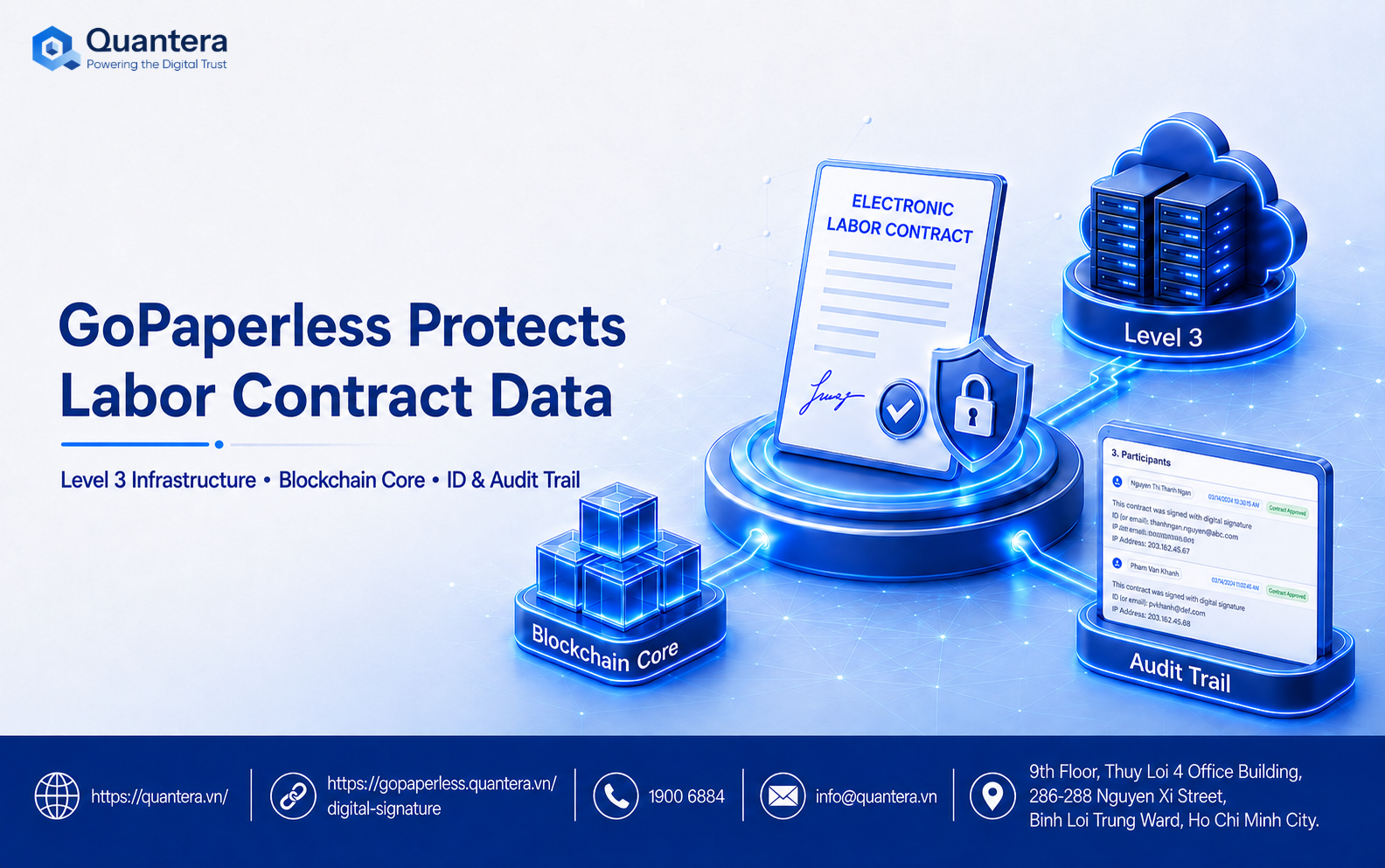
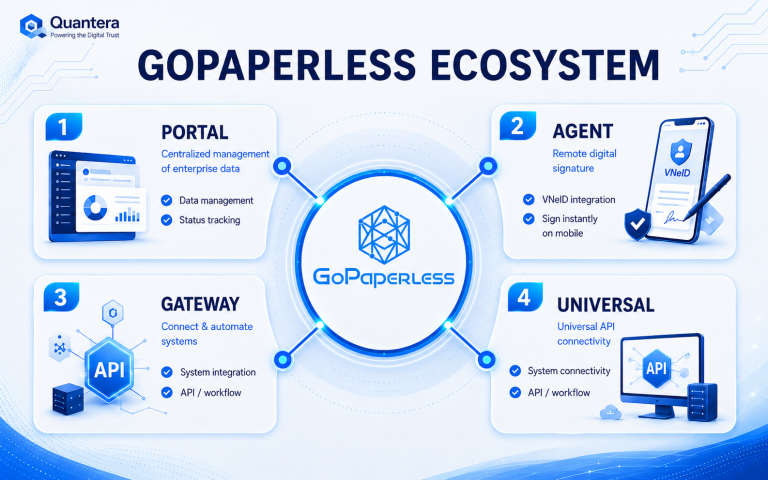
To operate a system that fully meets the stringent requirements above, the Quantera brand, a decentralized technology infrastructure solution, has developed the GoPaperless solution with superior security standards specifically designed for B2B environments:
Level 3 server infrastructure: GoPaperless is hosted on a server system that meets at least Level 3 network information security standards under regulations of the Ministry of Information and Communications, a specialized level intended for systems containing sensitive organizational information.
Secured by Blockchain Core (Hyperledger Fabric): Contract data is not stored centrally at a single point that is vulnerable to attack, but is distributed into encrypted blocks on a permissioned Blockchain platform. Any attempt to infiltrate, steal, or unlawfully alter documents is immediately rejected.
Lookup via ID and Transaction Log (Audit Trail): Every contract on GoPaperless is permanently linked to an ID and a “Transaction Log” file that records every access action in detail down to the second. HR can easily retrieve records to process social insurance, tax matters, or sign electronic employment contracts without Level-2 VNeID while still fully maintaining valid data traceability.
4. Conclusion
An enterprise’s electronic employment contract data is by no means fragile or prone to disappearing like ordinary computer files. It is securely “sealed” through a multi-layer storage mechanism operating in parallel between the State and the service provider, together with backup and automatic freezing scenarios.
Choosing a technology partner with extensive infrastructure capabilities such as Quantera is the strongest layer of insurance for your digital assets.
Is your enterprise ready to protect HR data according to the highest standards?

Community Discussion