


Digitally Signed Electronic Documents Replacing Paper Documents from November 1, 2026: What Should Enterprises Prepare?
From November 1, 2026, Decision No. 43/2026/QD-TTg officially takes effect, promulgating the Regulation on the management, operation, exploitation, and use of the National Document Interconnection Axis.
The new regulation continues to promote the sending and receiving of documents entirely in the electronic environment, under which documents that are digitally signed in accordance with regulations have the same legal validity as original paper documents when circulated through the Interconnection Axis, except where specialized laws provide otherwise.
However, this should not be simply understood to mean that “from November 1, 2026, every enterprise is required to eliminate all paper documents.”
The more important point lies in how an electronic document is managed: rather than being drafted on a computer, printed for handwritten signature, and then scanned into a PDF, the process is intended to be carried out from beginning to end in an electronic environment.
In this article, Quantera will outline 5 steps enterprises can apply to gradually transition their approval and signing processes from paper to electronic form, while improving control over signatures, authorized persons, document versions, and processing history.
1. How Will Electronic Documents Change from November 1, 2026?
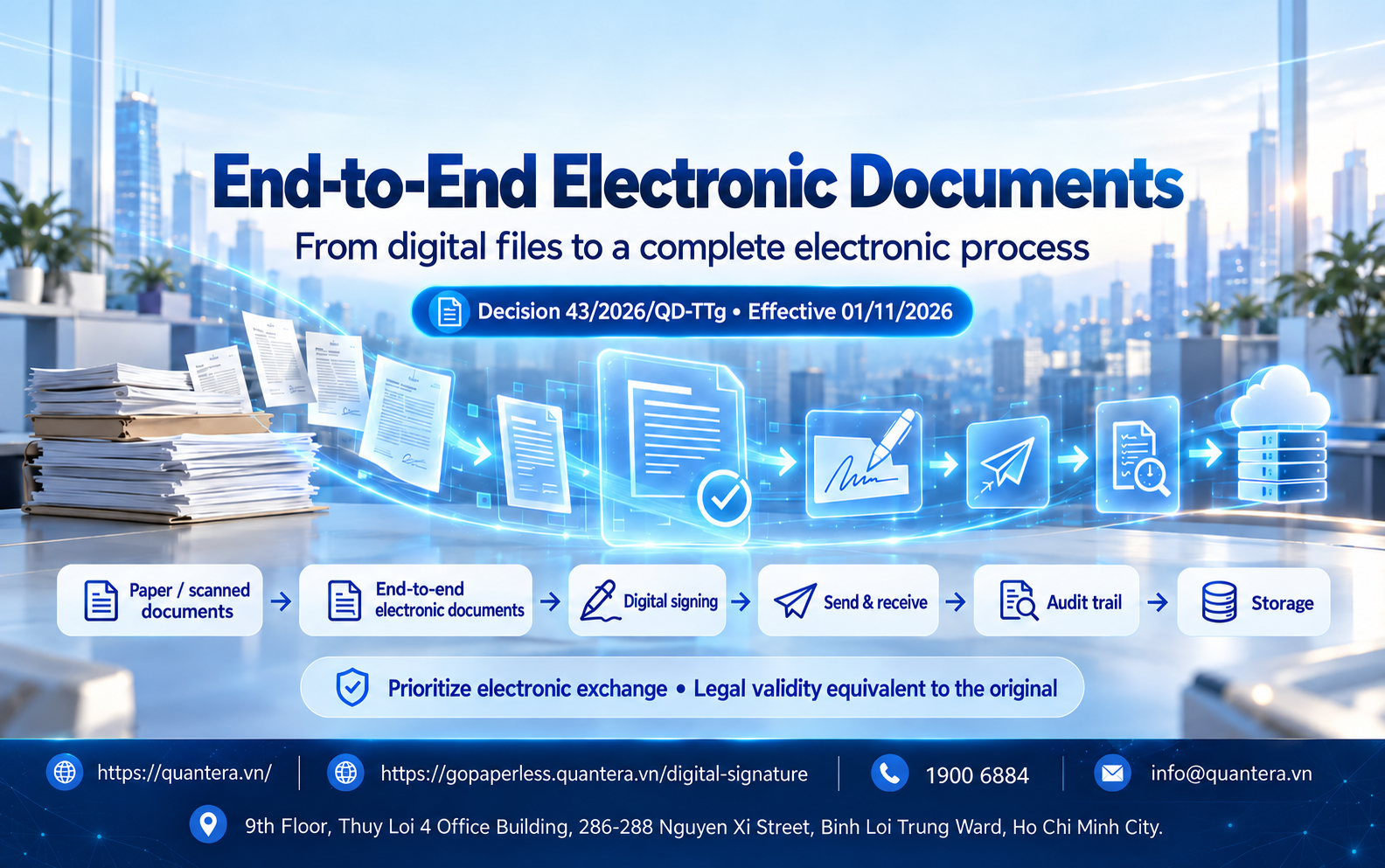
Decision No. 43/2026/QD-TTg takes effect on November 1, 2026. This document regulates the management and operation of the National Document Interconnection Axis for sending and receiving electronic documents and data messages.
One of the most important concepts is the fully electronic document.
Under the Regulation, this is a document that is created, digitally signed, issued, sent, and received entirely in an electronic environment, without the parallel use of a paper version and without being a paper document that has simply been scanned into a file.
The Regulation also establishes the principle of prioritizing the sending and receiving of fully electronic documents and implementing a roadmap to minimize the use of documents digitized from paper originals.
In addition, electronic documents that are digitally signed in accordance with regulations have the same legal validity as original paper documents when circulated through the Interconnection Axis.
Based on this principle, when implementing eContract, enterprises should also require the system to be capable of checking signing status, verifying digital signatures, and providing alerts for cases that do not yet satisfy the required conditions.
View the full text of Decision No. 43/2026/QD-TTg on the Government Electronic Information Portal.
Therefore, the key issue is not merely “eliminating paper,” but moving from an electronic file to a complete electronic process.
2. 5 Steps to Move from Paper Documents to a Digitally Signed Electronic Process
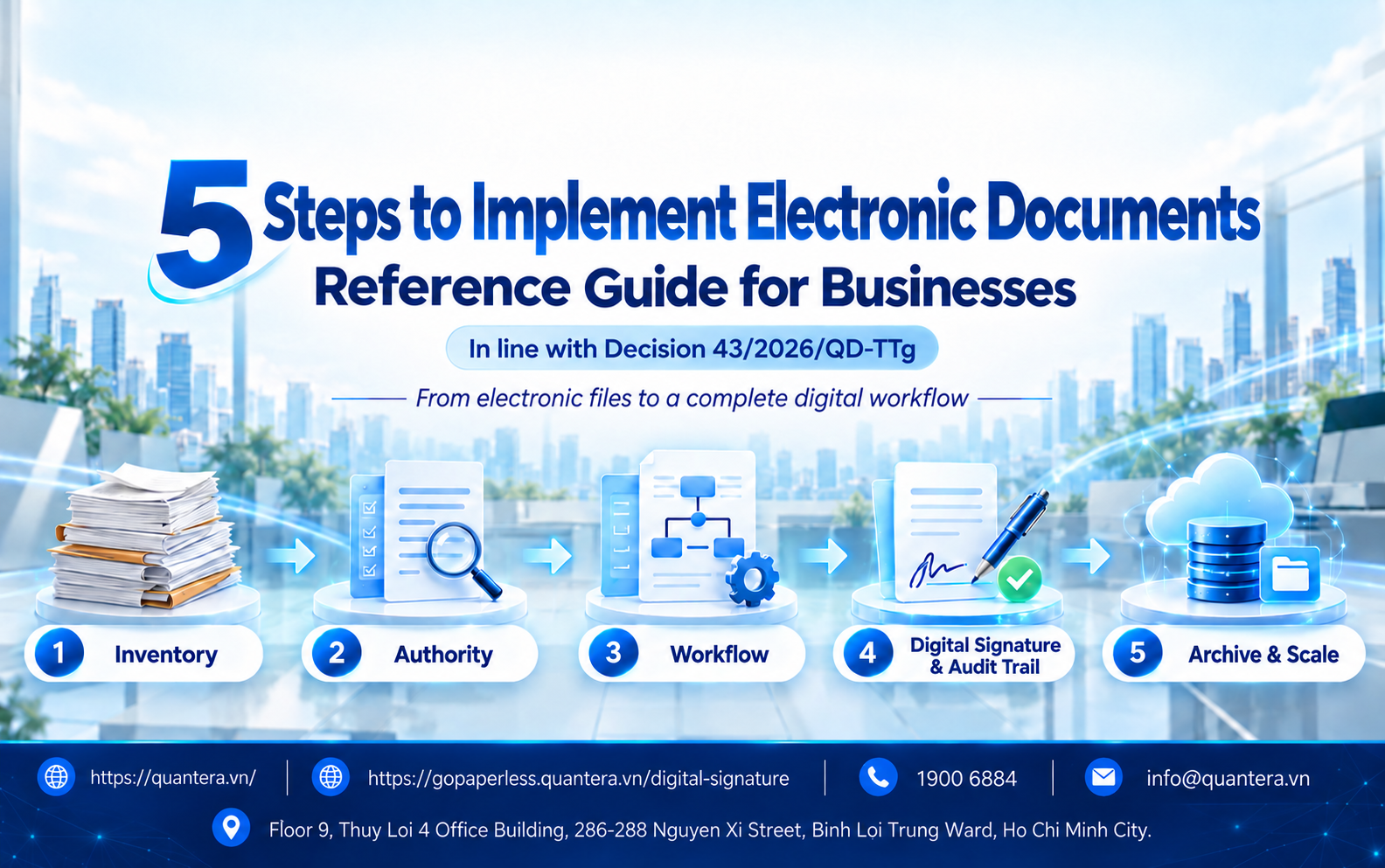
The following 5 steps are implementation suggestions for enterprises referring to the electronic document management model under Decision 43. They are not a mandatory procedure that every enterprise must apply under this Decision.
2.1. Inventory the Types of Documents Currently in Use
Enterprises should not begin by purchasing digital signatures for every employee or uploading all existing templates to a system.
First, the enterprise needs to understand which types of documents it is currently using and how those documents are being processed.
They can be divided into groups such as:
- Internal documents;
- Requests and submissions;
- Decisions;
- Documents requiring multiple levels of approval;
- Documents requiring signatures from authorized persons;
- Contracts and appendices;
- Documents sent to customers and partners;
- Documents requiring long-term storage.
The enterprise should then prioritize document types that have high volumes, pass through many people, or currently take significant time to obtain approval and signatures.
For example, if a purchase request currently requires downloading an Excel file, emailing it to a manager, forwarding it to Accounting, and then printing the final version for the Director to sign, this is a suitable process to consider digitizing first.
See the key points enterprises should prepare before digitization in Top 5 Things Enterprises Should Note When Implementing Digital Transformation.
2.2. Clearly Determine Who Can Approve and Who Can Sign
After identifying the document groups to be converted, the next step is to clarify authority.
For each type of document, the enterprise should be able to answer:
- Who creates the document?
- Who reviews the contents?
- Who approves it?
- Who has signing authority?
- If the signer is absent, who may be authorized to sign?
- Is that authority limited by business unit, transaction value, or document type?
This is extremely important.
If an internal process has not clearly defined who is permitted to do what, putting that process into software does not automatically make it correct. Technology only makes the rules that the enterprise has established operate faster.
Therefore, before designing a secure electronic approval and signing system, the enterprise needs to complete its matrix of document creators, reviewers, approvers, signers, and authorization scenarios.
2.3. Design an End-to-End Electronic Process
One common mistake is to convert the process in the following way:
Draft on computer → Print → Hand-sign → Scan → Send PDF → Store on Drive.
This approach reduces some paper transportation, but it does not create a fully electronic process.
The new process should instead aim for:
Create document → Review → Approve → Digitally sign → Issue → Send/Receive → Store.
Every step is performed electronically, and the result of the previous step is transferred directly to the next step.
For example, once a Department Head approves a document, it can automatically move to the authorized signer instead of requiring an employee to download the file and resend it by email.
This is the essence of digitizing B2B approval and signing processes and automating workflow management.
2.4. Control Digital Signatures, Permissions, and Processing History
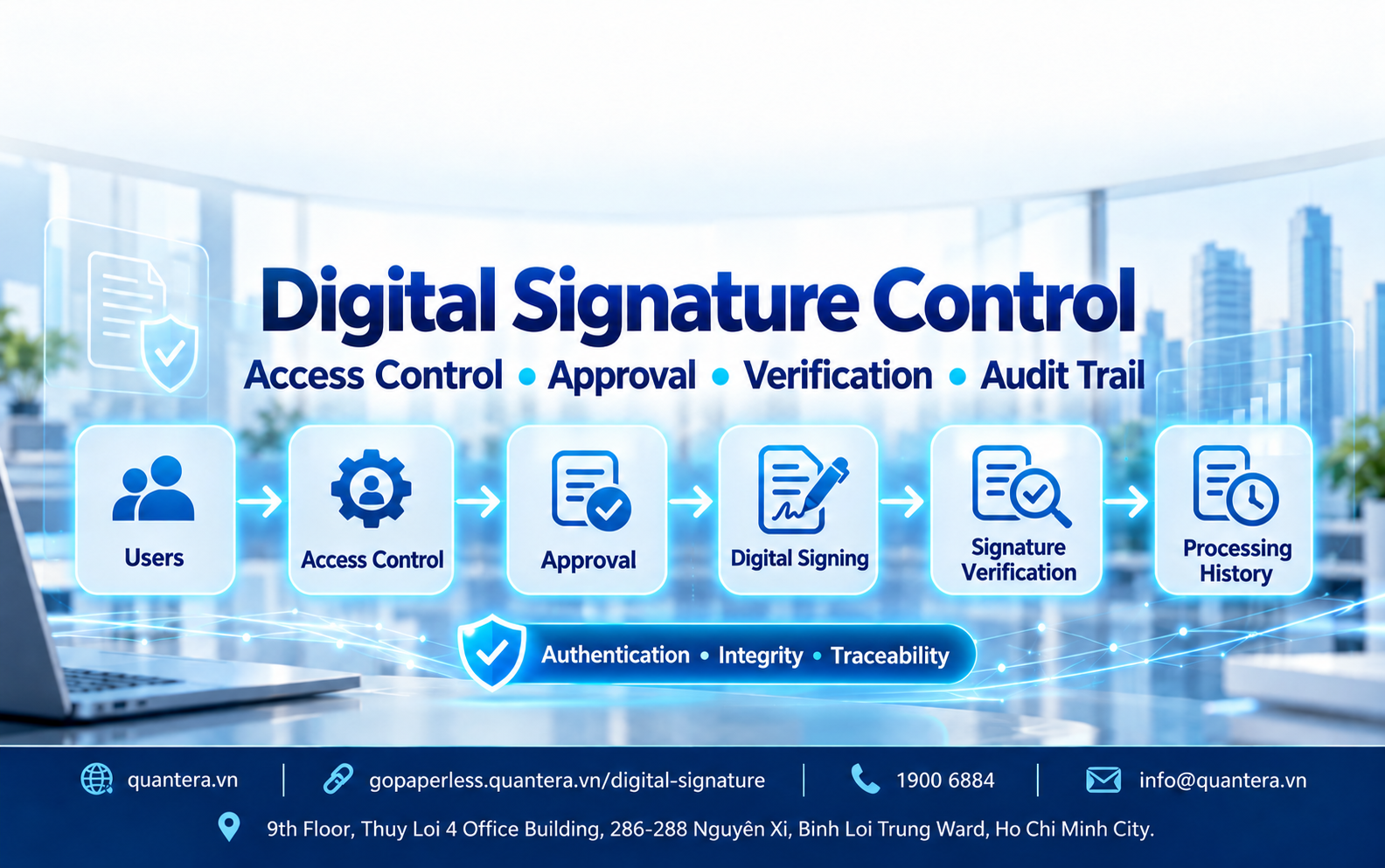
When documents no longer circulate on paper, enterprises need a way to prove what has occurred in the electronic environment.
At a minimum, the enterprise should be able to control:
- Who can view the document;
- Who can edit it;
- Who can approve it;
- Who can sign it;
- How many times the document has been changed;
- Which version is the final version;
- Whether the signature is valid;
- Who performed each action;
- When each action was performed.
This principle is also clearly reflected in Decision 43: data exchanged through the Interconnection Axis must ensure confidentiality and integrity, while transactions must be authenticated and logged for inspection and retrieval.
More broadly, the 2023 Law on Electronic Transactions is also an important legal foundation for establishing the legal validity of data messages and electronic transactions.
View the full text of Law on Electronic Transactions No. 20/2023/QH15.
2.5. Store and Pilot the Process Before Discontinuing Paper
Completing the signature does not mean that the process is finished.
Enterprises need to determine where documents will be stored, who has the right to retrieve them, how the final version will be identified, and how long the processing history will be retained.
Decision 43 also provides that agencies and organizations sending and receiving electronic documents through the Interconnection Axis are responsible for storing electronic documents and ensuring their legal validity throughout the retention period.
When applying this approach to internal processes, enterprises should not move everything to electronic form in a single day.
They can select a group of documents with a clearly defined process, conduct a pilot, and check:
- Is the correct approver involved?
- Is the correct signer involved?
- Can the digital signature be verified?
- Can document versions be confused?
- Can the processing history be retrieved?
- How does the system handle user errors?
Once these steps are stable, the enterprise can expand the model to other document groups.
3. Checklist Enterprises Should Complete Before Moving Fully to Electronic Processes
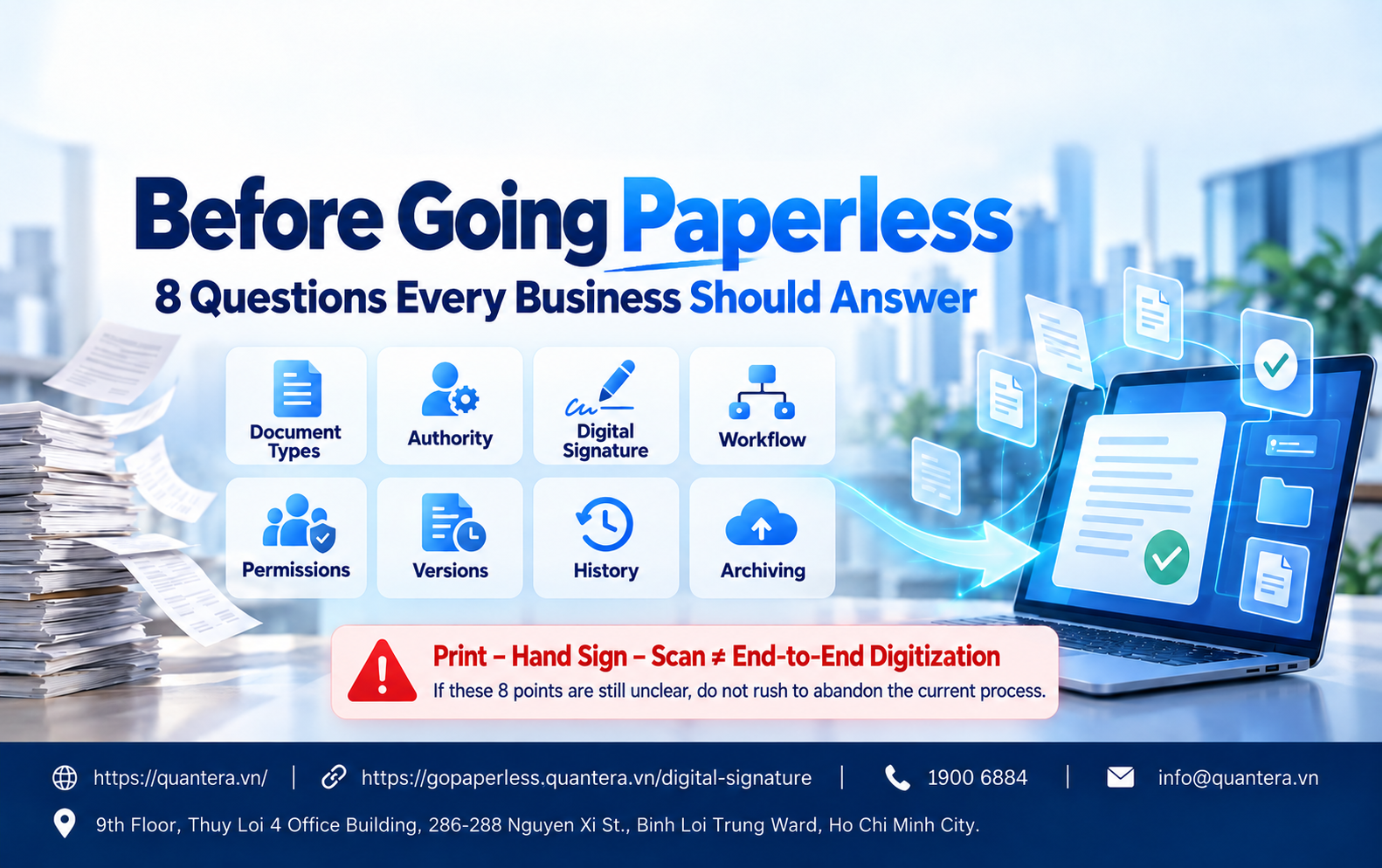
| Item to Review | Question the Enterprise Needs to Answer |
|---|---|
| Document type | Which documents should be converted to electronic form first? |
| Authority | Who is allowed to approve and who is allowed to sign? |
| Digital signature | Does the signer already have an appropriate signing method? |
| Process | Which steps must the document go through? |
| Permissions | Who can view, edit, approve, download, and sign? |
| Versions | How is the correct final version identified? |
| History | Can the enterprise identify who performed each action? |
| Storage | After signing, how is the document stored and retrieved? |
If the enterprise cannot yet answer these questions, it should not rush to eliminate its current process.
In particular: if documents still need to be printed for handwritten signatures and then scanned back into the system, the enterprise has digitized the document, but has not yet digitized the entire process.
4. What Should Enterprises Take Away from Decision No. 43/2026/QD-TTg?
There is one important point that needs to be understood correctly.
Decision No. 43/2026/QD-TTg regulates the National Document Interconnection Axis and the agencies and organizations participating in its connection. It is not a regulation requiring every enterprise in Vietnam to discontinue all paper documents from November 1, 2026.
In fact, the Regulation also provides that connections for sending and receiving electronic documents between state administrative agencies and organizations or enterprises must be established on the principles of voluntariness, equality, and security.
Enterprises therefore should not interpret the November 1 milestone as:
“From this date, every document in the company must be paperless.”
What is more important is that the document governance model is becoming increasingly clear:
Electronic creation → Electronic approval → Digital signature → Electronic sending/receiving → Storage → Retrieval and traceability.
This is an important signal for enterprises to review processes that still depend on paper documents, email, chat groups, or scanned files.
Instead of asking: “Should we purchase digital signatures?”
Enterprises should ask: “Which of our processes can be handled entirely in an electronic environment while still identifying the correct person, correct authority, correct version, and maintaining complete evidence?”
5. How Does GoPaperless Help Enterprises Move Approval and Signing Processes to Electronic Form?
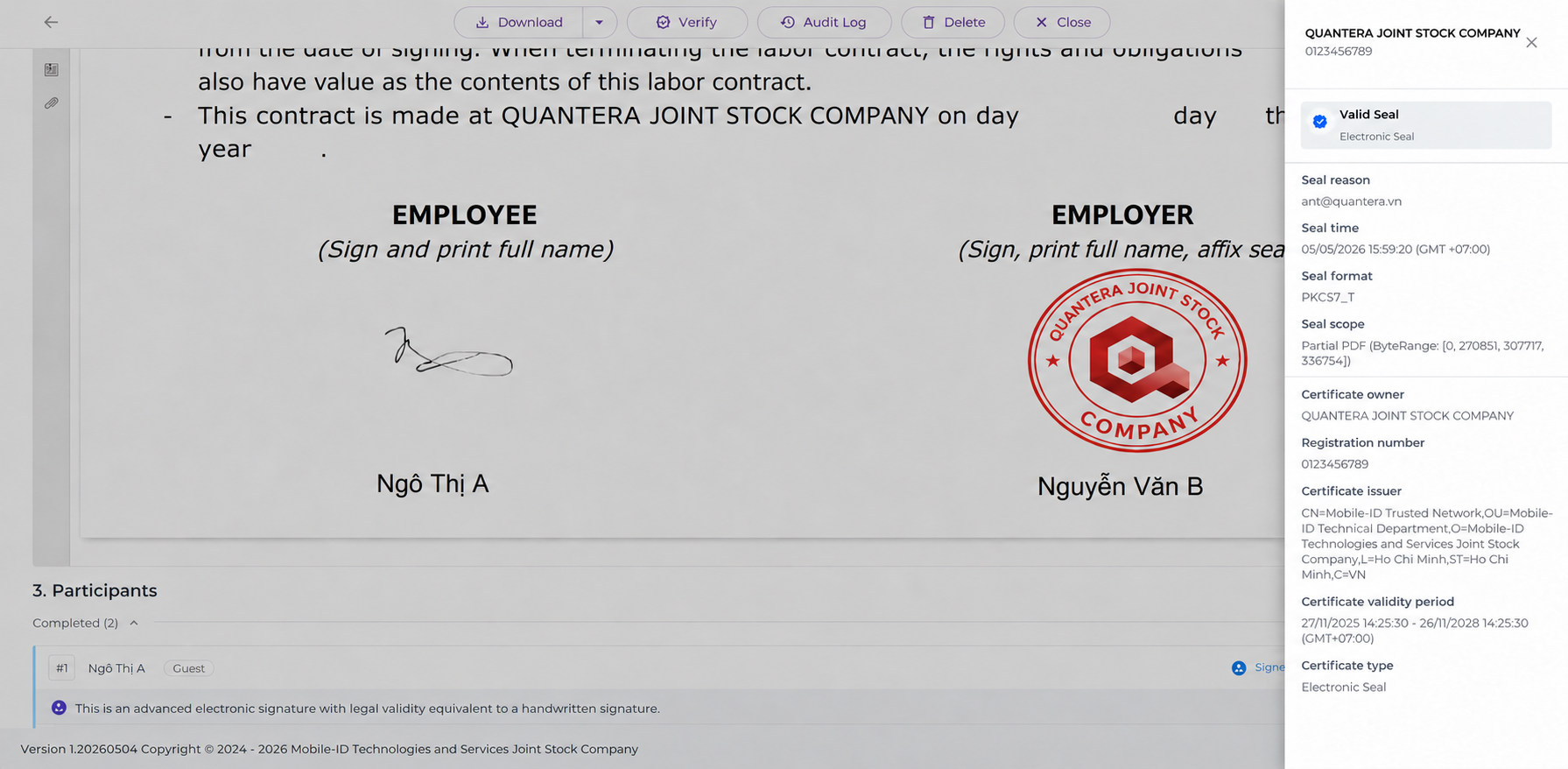
When moving from paper to electronic processes, enterprises need more than a tool for placing a signature on a PDF file.
The larger issue is managing who creates the record, which people it must pass through, who has signing authority, which version is currently being processed, and how the complete processing history is retained afterward.
GoPaperless is a solution from Quantera that helps enterprises digitize these processes from record creation and approval routing to electronic signing, status tracking, and transaction evidence retention.
GoPaperless is also designed to connect with systems already being used by enterprises rather than forcing users to move the entire process into a separate application.
Learn more about how GoPaperless is implemented: A-to-Z Guide to Digitizing the HR Department
For enterprises that already use ERP, HRM, CRM, or internal management software, integrating GoPaperless can add approval and electronic signing capabilities to existing processes, reducing the need to download files, resend them by email, or repeatedly enter the same data.
The important point is that GoPaperless does not decide on behalf of the enterprise which types of documents may be moved entirely to electronic form, but it can help enterprises incorporate principles of digital signing, access control, version management, and history retention into actual processes.
6. Conclusion
Moving from paper to electronic form is not simply a matter of turning a sheet of paper into a PDF file.
A complete electronic process must enable the enterprise to determine:
Who creates → Who approves → Who signs → Which version is effective → How the document was sent and received → Where history and evidence are stored.
The direction reflected in Decision No. 43/2026/QD-TTg also shows a clear trend: prioritizing documents processed entirely in the electronic environment and limiting the practice of signing on paper and then scanning.
For enterprises, this is an appropriate time to review approval and signing processes that still depend on paper and identify which document groups can be converted first.
There is no need to eliminate paper in a single day.
But starting with the first process, enterprises should follow the 5 steps correctly:
Inventory → Determine authority → Design the process → Control digital signatures and history → Store and expand.
👉 Join the Q&A – Human Resources, Labor and Payroll Community now to discuss real-world implementation scenarios, ask questions about system integration, and work with the Quantera team to resolve challenges during the digital transformation process.
7. Frequently Asked Questions about Digitally Signed Electronic Documents
Do digitally signed electronic documents have the same legal validity as paper documents?
Within the scope of Decision No. 43/2026/QD-TTg, an electronic document digitally signed in accordance with the law on electronic transactions has the same legal validity as the original paper document when circulated through the National Document Interconnection Axis, except where specialized law provides otherwise.
Beyond Decision 43, the legal validity of data messages and electronic transactions must also be assessed under the Law on Electronic Transactions and the specialized laws applicable to each type of transaction.
Is a scanned file from a paper document considered a fully electronic document?
No.
Under Decision 43, a fully electronic document must be created, digitally signed, issued, sent, and received entirely in the electronic environment; it is not a paper document scanned into a file.
Therefore, a scanned PDF may be an electronic file for storage or exchange, but it should not be treated as equivalent to the concept of a fully electronic document under this Regulation.
From November 1, 2026, are enterprises required to eliminate all paper documents?
That conclusion cannot be drawn from Decision No. 43/2026/QD-TTg.
The Decision governs the management and use of the National Document Interconnection Axis. Connections between state administrative agencies and enterprises are also based on the principles of voluntariness, equality, and security.
Enterprises need to review the laws applicable to each specific type of record, contract, or document before deciding to eliminate paper versions entirely.
Where should an enterprise begin when moving to electronic documents?
It should not begin with software.
Start in the following order:
Inventory documents → Identify approvers and signers → Design the process → Configure permissions and digital signatures → Pilot → Expand.
Once the enterprise has clearly identified these elements, selecting technology and implementing the solution will become much easier to control.
Community Discussion