


5 Steps to Review Employment Contracts under Decree 283/2026/ND-CP
The fact that an employment contract has been signed does not mean that an enterprise has fully controlled all risks.
Errors may arise from the probation stage, the selection of the contract type, the contents of the agreement, the actual assignment of work, through to amendments or termination of the employment contract.
From September 10, 2026, Decree 283/2026/ND-CP takes effect, prescribing violations, penalties, and remedial measures in the fields of labor, social insurance, and Vietnamese workers working abroad under contracts.
In this article, Quantera will guide enterprises through 5 important areas to review throughout the employment contract lifecycle, helping them identify potential errors before they become operational issues or are identified during an inspection by a competent authority.
1. Key Points Enterprises Should Note about Decree 283/2026/ND-CP
Decree 283/2026/ND-CP is a document regulating penalties; the obligations that enterprises must fulfill regarding employment contracts must still be reviewed in conjunction with the Labor Code and other relevant legal regulations.
An important point of Decree 283/2026/ND-CP is that employment contract violations are not limited to the time of signing.
Articles 15 to 18 prescribe violations directly related to the conclusion of employment contracts, probation, performance of employment contracts, and the amendment, supplementation, and termination of employment contracts.
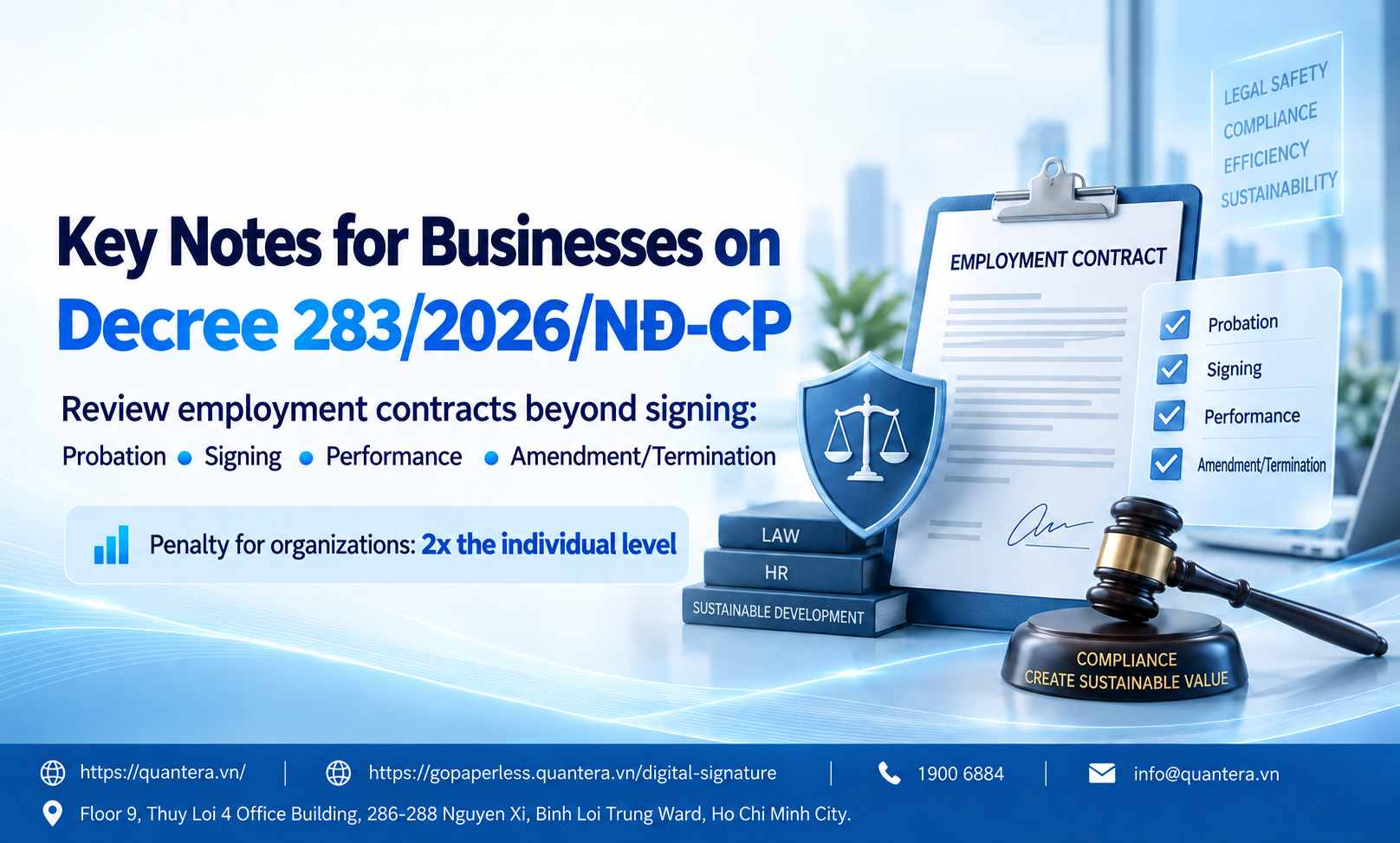
Enterprises should also pay particular attention to how penalty levels are interpreted. Under Article 7, the fines specified in these articles are, in principle, the amounts applicable to individuals; for enterprises that are organizations, the fine is twice the amount applicable to individuals.
Therefore, HR should not merely check whether “a contract has been signed,” but should review the entire process from the employee’s probation period until the employment relationship ends.
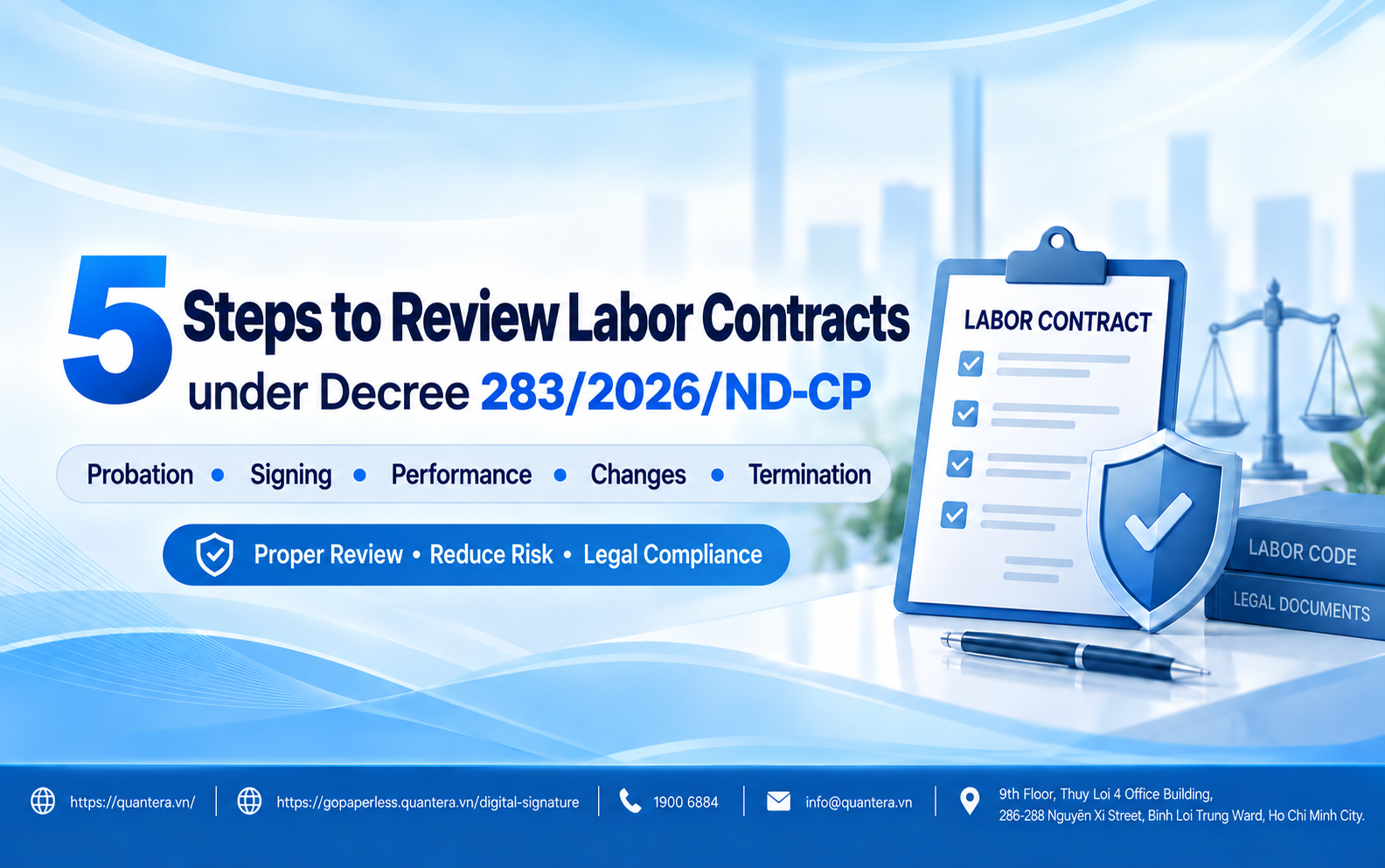
2. 5 Steps to Review the Employment Contract Lifecycle under Decree 283/2026/ND-CP
2.1. Review the Probation Stage
HR should begin with probation records instead of only reviewing employees who already have employment contracts.
Some questions that should be reviewed:
- Is an employee being required to undergo probation more than once for the same job?
- Does the probation period exceed the permitted limit?
- Is the probation salary lower than the agreed amount or below 85% of the salary for the job?
- If the parties entered into a probation contract and the employee has successfully completed probation, has the enterprise failed to conclude an employment contract?
Article 16 of Decree 283 provides penalties for the above violations. In addition to monetary fines, in certain cases the enterprise may also be required to pay the full amount of outstanding wages or conclude an employment contract with the employee.
At a minimum, HR should review: the probation start date, end date, probationary job, salary, result, and the date of transition to an employment contract.
2.2. Review the Conclusion of Employment Contracts
This is the group that should be given the highest priority.
Under Article 15, an enterprise may be subject to penalties if it is required to conclude an employment contract in writing but fails to do so, enters into the wrong type of employment contract, or the employment contract lacks the required principal contents. The penalty increases according to the number of affected employees.
HR should review:
- Have employees who are legally required to have a written employment contract been provided with one in full?
- Is the type of employment contract being used correct?
- Does the contract template contain all necessary information?
- Has an expired contract been properly handled when the employee continues working?
- Does the enterprise retain the originals of employees’ citizen identification cards, diplomas, or certificates?
- Does the enterprise require employees to provide money or assets as security for performance of the contract?
Article 15 also separately prescribes penalties for retaining employees’ original documents or requiring money or assets as security for the performance of an employment contract.
If the enterprise is transitioning to electronic contracts, electronic employment contracts must still comply with legal requirements on labor and electronic transactions.
2.3. Review the Performance of the Employment Contract after Signing
Even if a contract is correct at the time it is signed, risks may still arise if actual operations differ from what was agreed.
HR should review:
- Is the employee performing the job that was agreed upon?
- Is the actual workplace consistent with the employment contract?
- When transferring an employee to another job, does the enterprise comply with the required conditions and time limits?
- Is the employee notified in advance before being temporarily assigned to another job?
Article 17 provides, for example, that temporarily assigning an employee to another job without at least 3 working days’ prior notice, without clearly stating the duration, or assigning unsuitable work may be subject to penalties.
Assigning an incorrect workplace or transferring an employee to another job without satisfying the required conditions also falls within this group of violations.
This shows that HR should not simply store the contract after signing and consider contract management complete. Employment contracts need to be monitored throughout their effective period.
2.4. Review Appendices, Amendments, and Contract Terms
During employment, job titles, salaries, duties, or other contents may change.
HR needs to know:
- What content has changed?
- Has the change been properly recorded?
- Which version of the contract is currently being used?
- Which appendices remain effective?
- Which contracts are about to expire?
- Who is responsible for handling them before the expiration date?
One noteworthy point in Article 18 is that amending the term of an employment contract through an employment contract appendix falls within the group of acts that may be subject to penalties.
Therefore, managing versions and contract terms is not only intended to make records easier for HR to locate, but also helps limit incorrect handling during the contract amendment process.
2.5. Review the Employment Contract Termination Process
When an employee leaves the company, the employment contract process does not immediately end on the employee’s last working day.
HR still needs to review:
- Is this a case in which written notification of termination is required?
- Have employee entitlements been paid within the required time limit?
- Has severance allowance or job-loss allowance, where applicable, been properly handled?
- Have procedures for confirming the employee’s social insurance and unemployment insurance contribution period been completed?
- Have all documents retained by the enterprise been returned?
- When an employee requests documents relating to their employment history, can the enterprise provide them?
Article 18 directly regulates violations relating to failure to provide termination notice where required, late or insufficient payment of employee entitlements, failure to complete social insurance and unemployment insurance procedures, and failure to provide relevant documents when requested by an employee.
3. Quick Checklist for HR to Review Employment Contracts
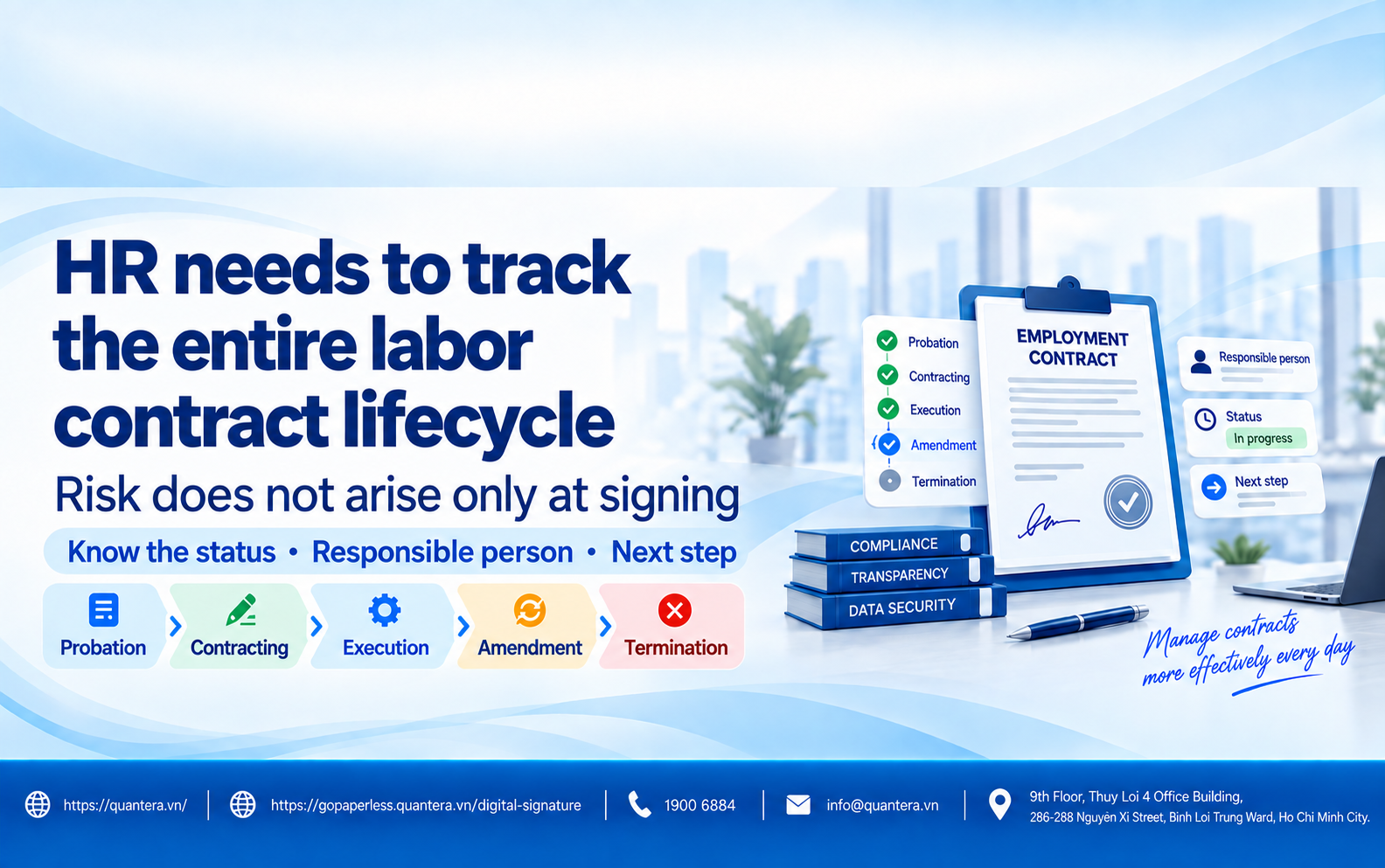
The key point HR should remember is: Risk does not arise only when an employment contract is signed. It may occur at any stage of the contract lifecycle.
Therefore, instead of merely checking whether a PDF folder is complete, an enterprise should know the status of each contract, who is currently handling it, and what the next step is.
| Stage | What HR Needs to Review | Required Outcome |
|---|---|---|
| Probation | Duration, salary, result | No employee requiring transition to an employment contract is overlooked |
| Contract Conclusion | Form, employment contract type, contents | Correct type and complete information |
| Performance | Job, workplace, reassignment | Actual implementation is consistent with the agreement |
| Amendments | Appendices, term, versions | Know exactly which version is currently effective |
| Termination | Notice, entitlements, social insurance, records | Complete all obligations following termination |
4. How Do Electronic Employment Contracts Help Enterprises Control Risk?
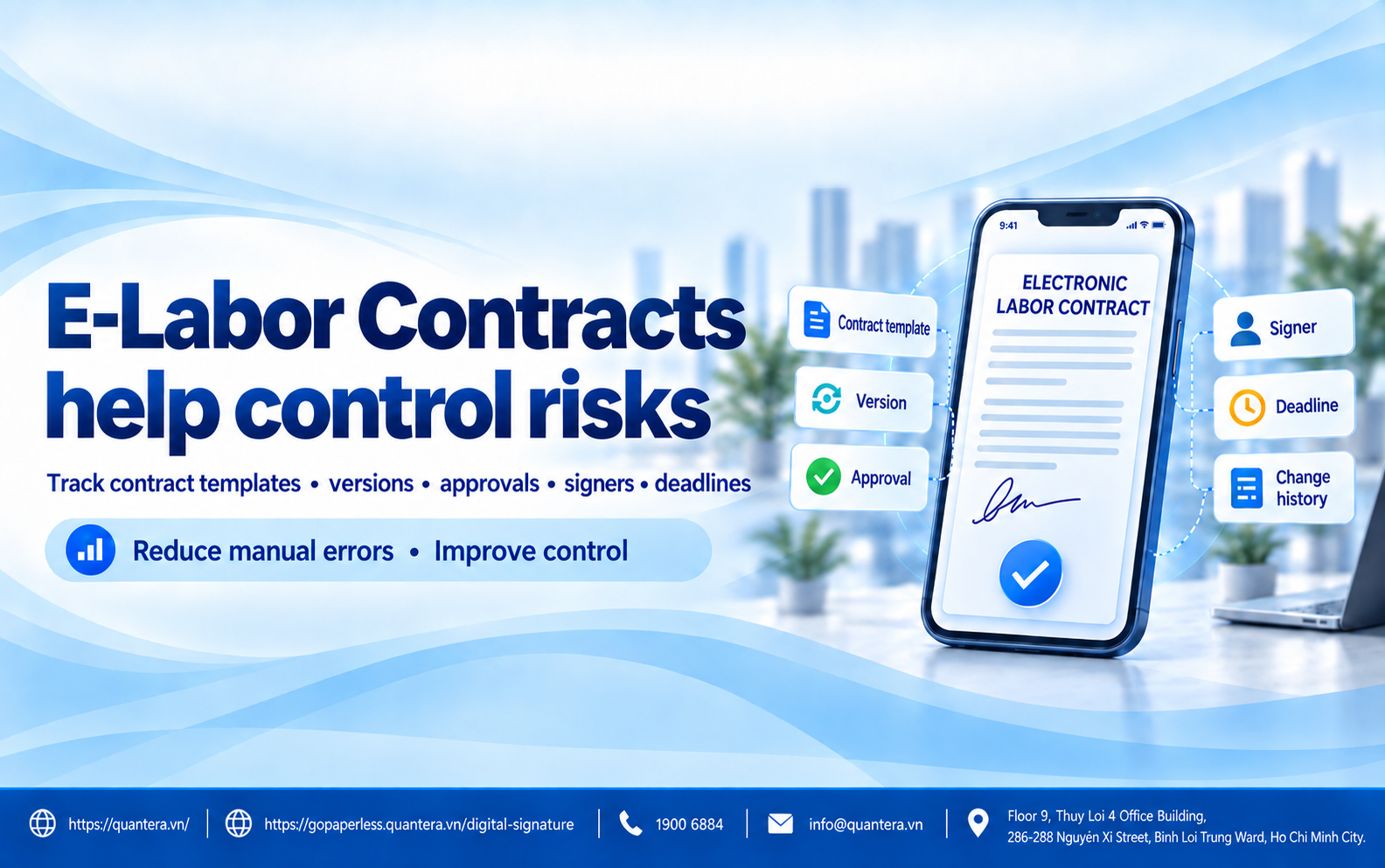
Electronic employment contracts do not automatically make an enterprise legally compliant. The contract contents, contract type, authorized person, and the way the enterprise performs the employment contract must still comply with applicable regulations.
The value of digitization lies in helping HR better control issues that were previously easy to overlook when records were managed through paper documents, Excel files, or multiple separate folders.
The system can help enterprises identify which contract template is being used, which version is final, who approved it, who has signing authority, which contracts are pending, which contracts are approaching expiration, and the history of changes made to each record.
For electronic employment contracts, Decree 337/2025/ND-CP also imposes specific requirements on eContract solutions, such as digital signing, digital signature verification, data protection, accessibility for retrieval, subject identification, and storage that preserves data integrity.
Technology does not determine whether an employment contract is legally correct or incorrect on behalf of the enterprise, but it can help reduce errors caused by manual management, missed deadlines, or the use of incorrect document versions.
5. How Does GoPaperless Help Enterprises Manage the Employment Contract Lifecycle?
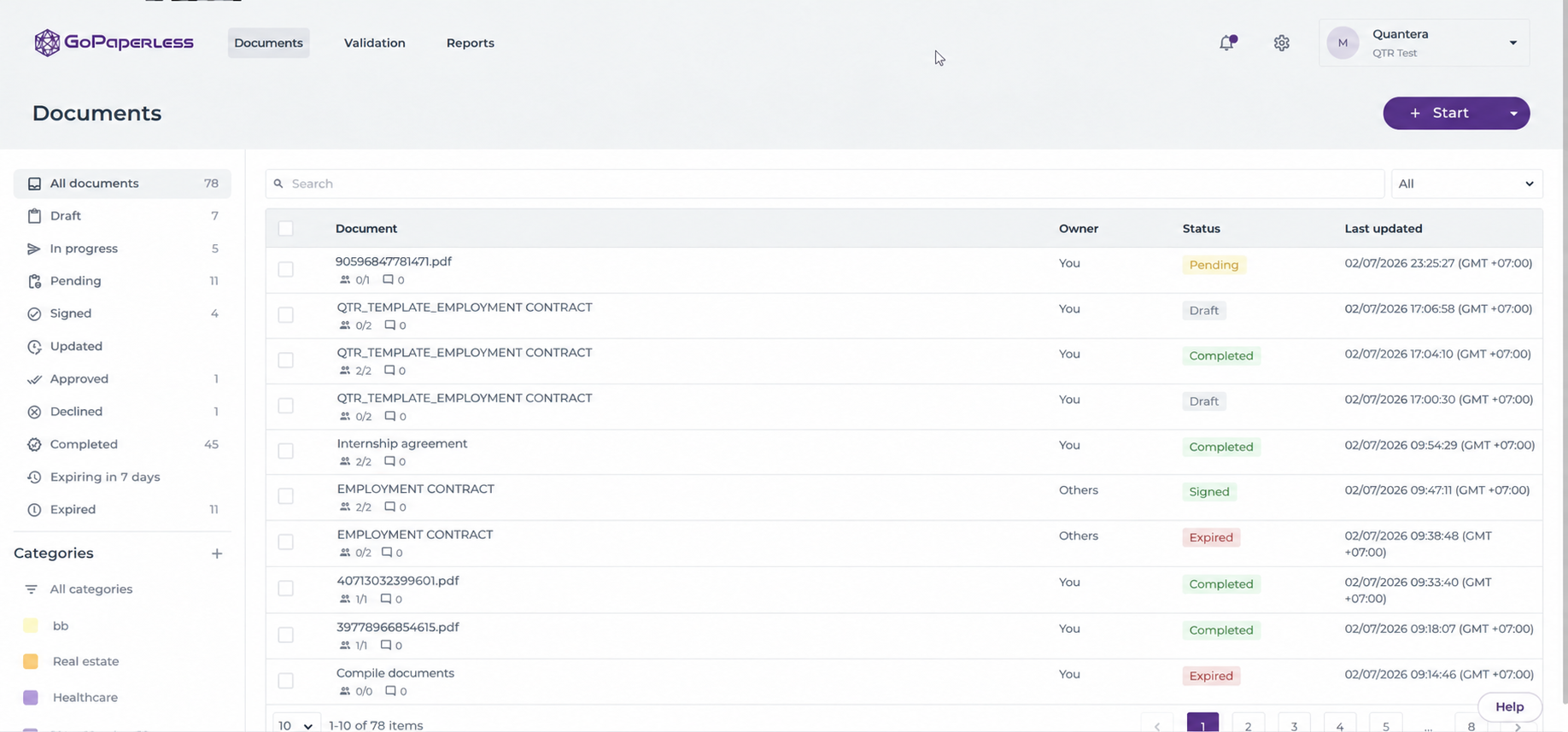
When an enterprise manages hundreds or thousands of employment contracts, the issue is no longer simply “using electronic signatures instead of signing on paper.” More importantly, the enterprise needs to control the entire lifecycle of each record.
GoPaperless is an electronic contract solution from Quantera, helping enterprises manage the process from record creation, approval, contract conclusion, and electronic signing to status tracking, version management, and retention of processing history.
For enterprises that already use HRM or ERP systems, GoPaperless can be integrated into the existing system to add electronic contracting and signing capabilities, reducing the need for HR to re-enter data or move between multiple systems during processing.
GoPaperless helps enterprises better control processes and evidence; however, responsibility for ensuring the contents of employment contracts and their lawful performance remains with the enterprise.
6. Conclusion
Decree 283/2026/ND-CP shows that employment contract management should not stop at the question “Has the contract been signed?”
Enterprises need to control the entire lifecycle:
If any of these stages is still managed through Excel, email, paper records, or depends on HR remembering deadlines, the enterprise still faces the risk of overlooking issues even when the original employment contract has been properly signed.
Therefore, the appropriate direction is not simply to convert paper contracts into electronic files, but to build a process that enables the enterprise to know where each record is, who is responsible, which version is currently effective, and what evidence has been retained.
👉 Join Q&A – Human Resources, Labor and Payroll Community now to discuss real-world implementation scenarios, ask questions about system integration, and work with the Quantera team to address challenges during the digital transformation process.
7. Frequently Asked Questions
When does Decree 283/2026/ND-CP take effect?
The Decree was issued on July 15, 2026 and takes effect from September 10, 2026.
Can an enterprise be penalized for failing to conclude an employment contract in writing?
Yes, if the case is one in which the law requires the employment contract to be concluded in writing.
An employment contract concluded through electronic means in the form of a data message in accordance with the law on electronic transactions has the same value as a written employment contract.
Article 15 provides penalties for failure to conclude a written employment contract with an employee performing work with a term of one month or more, as well as certain other specifically prescribed cases.
Can an enterprise be penalized for using the wrong contract type or for an employment contract that lacks required contents?
Yes. Article 15 includes both the conclusion of an incorrect type of employment contract and the conclusion of an employment contract that does not contain all required principal contents among the acts subject to penalties.
Does using electronic employment contracts automatically help an enterprise avoid violations?
No. Electronic employment contracts help enterprises better control processes, data, versions, and evidence. However, enterprises must still ensure that the contract type, contents, authorized person, and implementation process comply with the law.
Community Discussion