


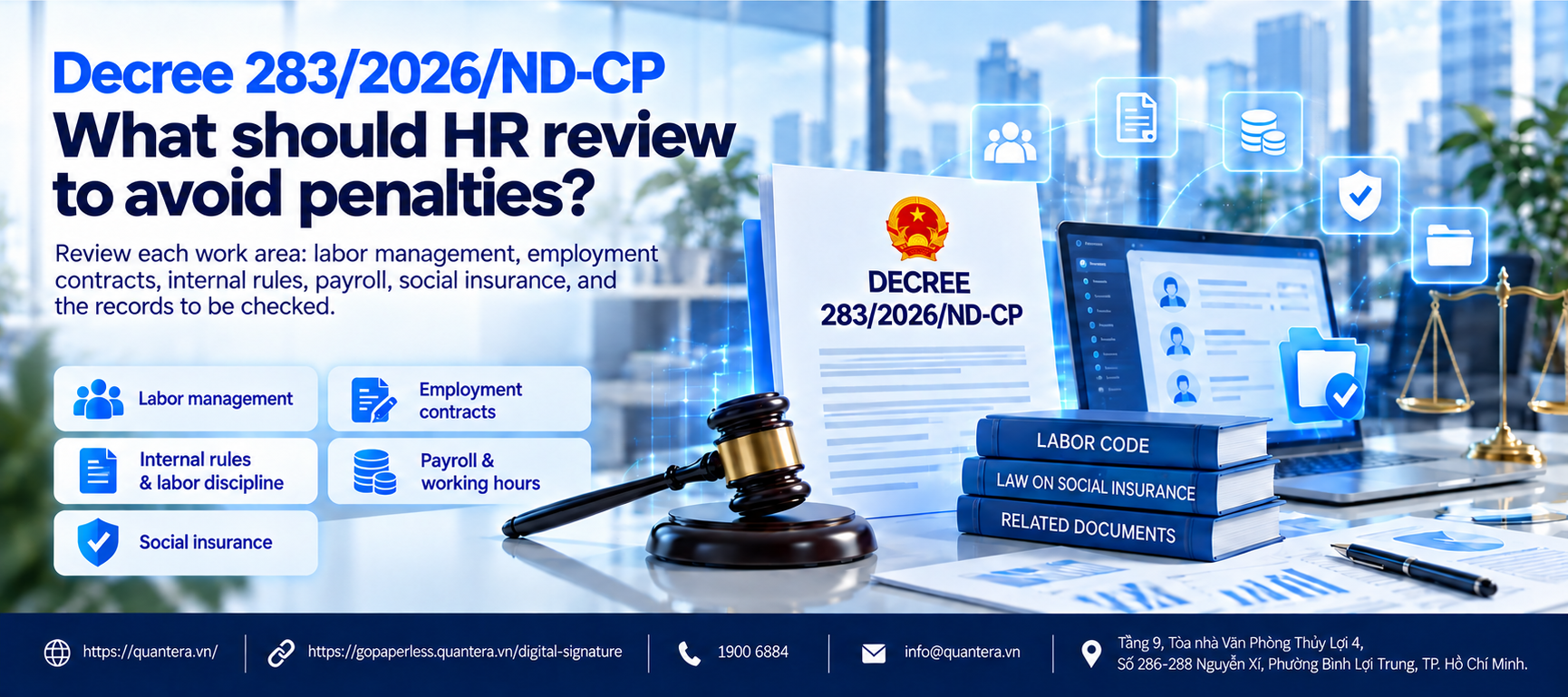
Decree No. 283/2026/ND-CP: What Should HR Check to Avoid Penalties?
Decree No. 283/2026/ND-CP was issued by the Government on July 15, 2026 and took effect on September 10, 2026. It provides for administrative penalties in the fields of labor, social insurance, and Vietnamese workers working abroad under contracts.
For HR, the issue is no longer simply whether the team knows that Decree 283 exists. The more difficult question is: among the dozens of tasks handled every day, which ones can expose the business to penalty risks if they are incomplete, delayed, or unsupported by sufficient records proving they were performed?
A business may already have signed employment contracts with all employees but still fail to update its employee management book. A company may have internal labor regulations, but the version currently circulated to employees may not be the version that was registered.
HRM data may show 250 people currently working, while the social insurance list includes only 247 people. Or the business may pay salaries regularly but, when reconciliation is needed, cannot assemble timesheets, payroll statements, and overtime records.
That is why HR should not read Decree 283 merely as a list of penalty amounts. A more useful approach is to go back to the workstreams HR is already managing, then check whether each obligation has been performed correctly and what evidence the business has to prove it.
It should also be noted that Decree 283 is a document regulating violations, penalty levels, and remedial measures. The specific obligations that businesses must perform still need to be cross-checked against the Labor Code, the Law on Social Insurance, and relevant regulations. Under Article 7 of Decree 283, the monetary fine imposed on an organization is, in principle, twice the fine imposed on an individual.
In this article, Quantera will help HR review Decree No. 283/2026/ND-CP by practical workstream, from workforce management, employment contracts, and internal labor regulations to payroll and social insurance, while also identifying the records and evidence that businesses should go back and check instead of reading the entire Decree to find the relevant provisions.
1. Which HR Workstreams Are Affected by Decree No. 283/2026/ND-CP?
Decree 283 has a fairly broad scope. Therefore, if HR starts by reading sequentially from Article 1 to Article 68, it is easy to end up knowing many penalty levels while still not knowing what should be checked first tomorrow.
For a typical business, HR can start with the five groups of work closest to daily operations: workforce management; employment contracts; internal labor regulations and labor discipline; wages and working time; and compulsory social insurance.
Only after that should HR expand to specialized groups if the business employs foreign workers, minor workers, engages in labor subleasing, or sends Vietnamese workers abroad under contracts.
The important point is to view the Decree through the employee lifecycle. An employee starts when they are recruited and entered into the employee management book, then goes through probation, execution of an employment contract, performance of work, receipt of wages, participation in social insurance, compliance with internal regulations, and eventually changes to or termination of the employment relationship.
At every stage, there are records, deadlines, and evidence that HR needs to manage.
Therefore, instead of asking “How many violations are penalized under Decree 283?”, HR should ask: “At each stage of the employee lifecycle, what records does the business have to prove that it has performed its obligations correctly?”
2. Workforce Management: Does HR Have All Required Books and Reports?
This is one of the workstreams most easily overlooked because it does not occur at a major event such as signing or terminating an employment contract. It happens quietly whenever a new employee joins, an employee leaves, or employee information changes.
Article 11 of Decree 283 provides penalties for acts such as failing to declare the use of labor, failing to record or fully enter employee information into the employee management book from the date the employee starts working, or failing to present the book when requested by a competent authority.
The Decree also penalizes failure to report changes in labor use, or failure to create the employee management book, creating it late, or failing to ensure the required basic contents.
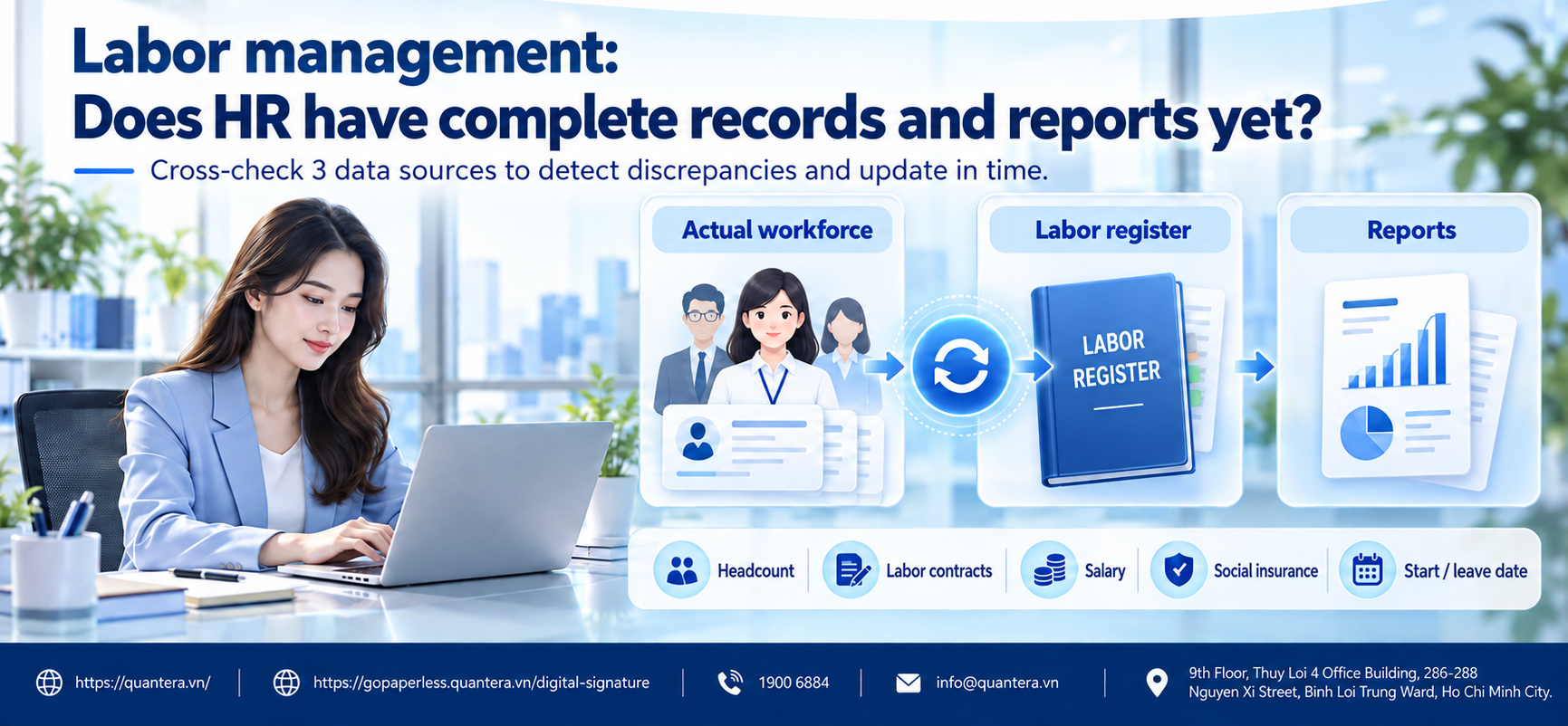
Therefore, HR’s first step should not be to open a new reporting template, but to reconcile three existing data sources: the actual employee list, the employee management book, and the data currently used to report to state authorities.
If the business has 300 people currently working but the employee management book contains only 292 people, the issue to be addressed is already clear. If an employee has changed job title, salary, or employment contract type but the book still contains the old information, HR also needs to update it.
The employee management book may be maintained on paper or electronically, but it must contain the required basic employee information and be updated throughout the employment period.
Next is the report on changes in labor use. Under the current rules, the report is submitted semi-annually before June 5 and annually before December 5.
At the present time, HR should pay particular attention to the annual reporting deadline before December 5, 2026.
HR should retain more than just the report file. It should also retain the source data used to prepare the report, proof of submission, the time of submission, and the person who performed it. This allows the business to reconcile later without depending on one employee’s memory.
3. Employment Contracts: What HR Should Check from Execution to Termination
Employment contracts are the area most likely to attract HR’s attention, but they are also easy to review incompletely.
A folder containing all contract files does not mean the business has controlled all risks. Errors can arise from the probation stage, using the wrong contract type, missing required content, inappropriate reassignment of employees, improper amendments through appendices, or failing to fully complete obligations upon termination.
Article 15 of Decree 283 provides penalties for acts such as failing to enter into a written employment contract when required by law, using the wrong type of employment contract, or using an employment contract that does not contain all required principal contents. The penalty increases according to the number of employees affected.
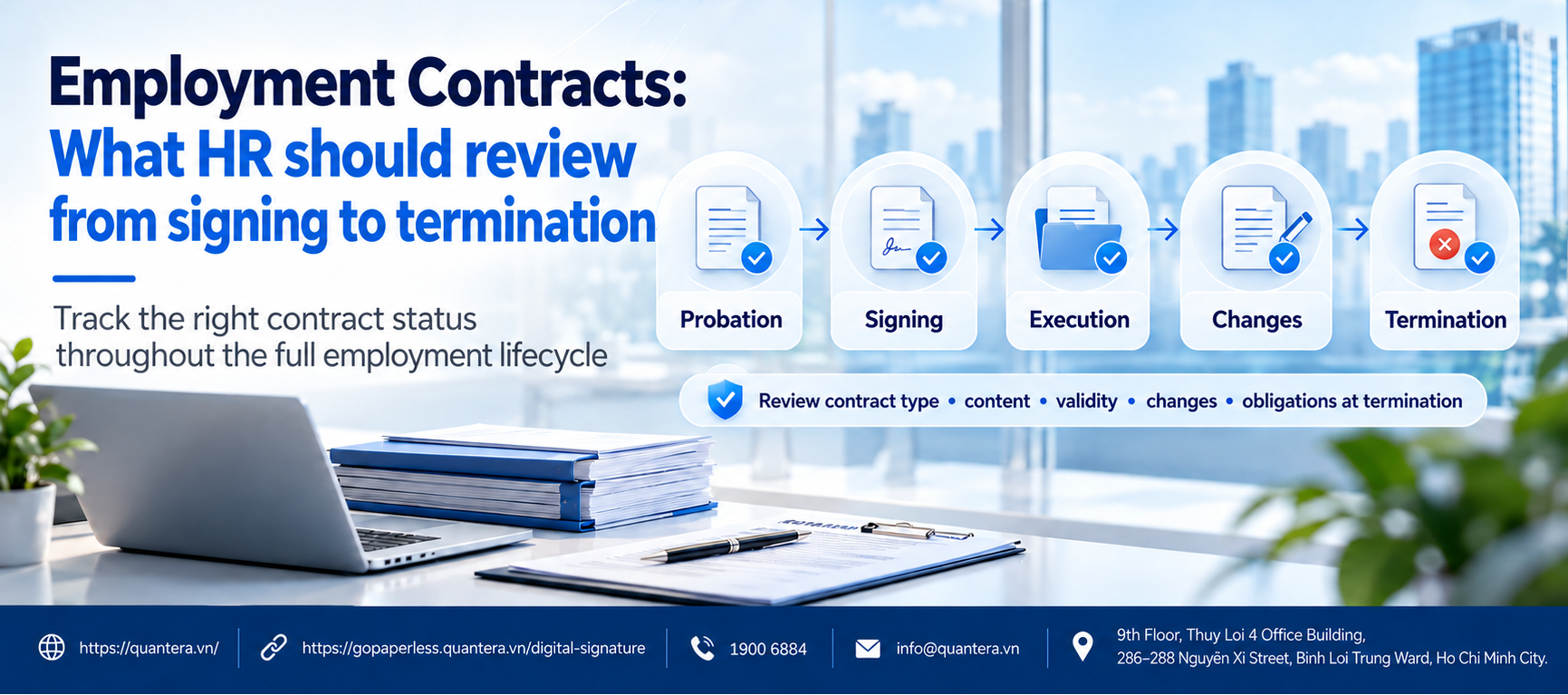
Therefore, HR should take the current employee list and review each group: employees on probation, employees who have become official staff, employment contracts approaching expiry, contracts whose terms have been changed, and employees whose employment has ended.
At the execution stage, HR should check the form, contract type, and template being used. During performance, HR needs to know which contracts have been amended, which version is currently effective, and which document records the change. Upon termination, HR should check notices, benefits that must be paid, social insurance procedures, and the return or provision of records to the employee where required by law.
Article 18 of Decree 283 also regulates violations related to amending, supplementing, and terminating employment contracts, including certain cases of failing to pay benefits within the required time limit, failing to complete procedures confirming periods of social insurance/unemployment insurance contributions, or failing to provide documents related to the employee’s work history when requested.
The key point to remember is that HR should not only check “Does this person have a contract?” HR must also know the contract’s current status, which version is effective, and what the next step in its lifecycle is.
4. Internal Labor Regulations and Discipline: Having a Document May Still Not Be Enough
A fairly common situation is that HR is asked, “Does the company have internal labor regulations?” and the answer is “Yes.”
But a deeper review may raise other questions: Is the version currently being applied the same version that was registered? Have the regulations taken effect? Have employees been notified? Have the main contents been posted where required? If the business has handled labor discipline cases, are the procedures and records complete?
Article 25 of Decree 283 provides penalties for failure to notify all employees of the internal labor regulations or failure to post the main contents where required. For employers with 10 or more employees, acts such as not having written internal labor regulations, failing to register them, failing to consult the grassroots employee representative organization where required, or using regulations that are not yet effective or have expired are also subject to penalties.
Therefore, HR should review a complete internal labor regulation file rather than only checking the Word or PDF version of the regulations.
That file should allow the business to answer: Which version is this? When was it issued? Were the required procedures completed? When did it take effect? How were employees notified? Is the business currently using that exact effective version?
If labor discipline cases have occurred, HR should take a few recent files and review them backwards. The fact that an employee actually committed a violation is not enough; the business must also ensure that the process, procedures, limitation period, and grounds for disciplinary action are appropriate.
The point HR should remember is: Having a policy does not mean the business has sufficient evidence to prove that the policy was issued and applied correctly.
5. Wages and Working Time: Are the Records Sufficient to Explain the Numbers on Payroll?
Wages are a workstream that HR/C&B handles every month, so it is easy to develop the feeling that “if payroll runs regularly, everything is probably fine.”
From a compliance perspective, however, the business needs to look beyond the employee’s net pay.
Decree 283 contains separate penalty provisions for violations relating to wages and working time/rest time. Relevant acts involve wage scales, payrolls, labor norms, bonus regulations, wage statements, timely payment of wages, overtime, night work, and related obligations.
HR/C&B should select several recent payroll periods and check whether all data can be linked end-to-end: what salary is stated in the employment contract and appendices, how many days/hours are recorded in the timesheet, whether overtime occurred, how payroll was calculated, what items appear on the wage statement, and what the final payment evidence shows.
If the business regularly uses overtime, it should also reconcile consent records for overtime, actual working time, and the amount paid.
The objective is not to create many more forms, but to ensure that when an employee or competent authority asks:
“Where did this number come from?”
HR/C&B can trace the number on the payroll back to timekeeping data, employment contracts, and the applicable policy without having to piece together information from multiple inconsistent sources.
6. Compulsory Social Insurance: Does the Actual Workforce Match the Participation List?
This is a workstream HR/C&B should prioritize early because Decree 283 distinguishes relatively clearly between late payment and evasion of compulsory social insurance contributions.
Under Clause 3, Article 43, the fine for individuals for certain late-payment violations is determined at 12%-15% of the total late-paid amount; Clause 2, Article 44 provides a rate of 18%-20% for certain evasion violations.
For a business that is an organization, the principle that the fine is twice the fine imposed on an individual under Article 7 must also be applied.
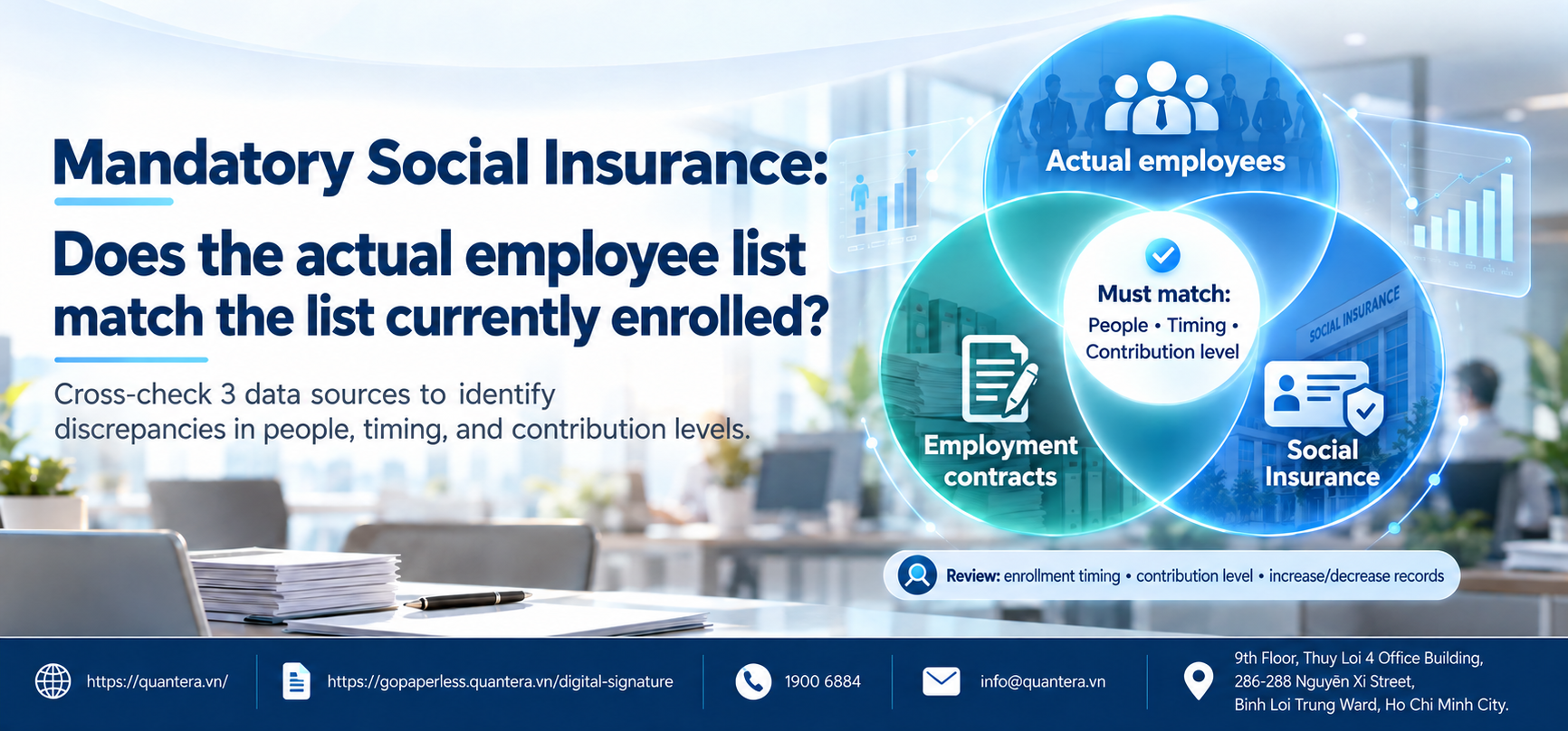
HR does not need to start by calculating penalties. A more useful step is to take the list of people actually working and reconcile it against the employment contract list and the compulsory social insurance participation list.
If the three lists do not match, determine the reason for each case.
Has an employee started work but not yet appeared in the social insurance records because documents are still being supplemented? Has someone terminated employment but not yet been removed? Has an employee’s salary serving as the contribution basis changed but the data has not been updated? Or is there a group of workers whose participation obligations have been classified incorrectly?
The review should not stop at whether a person participates or not. HR/C&B also needs to check the registration date, salary serving as the contribution basis, contribution period, and increase/decrease records.
This is an area where fragmented data can easily create risk. If HRM, employment contracts, payroll, and social insurance are being managed in four different files, the business should pay particular attention to reconciliation.
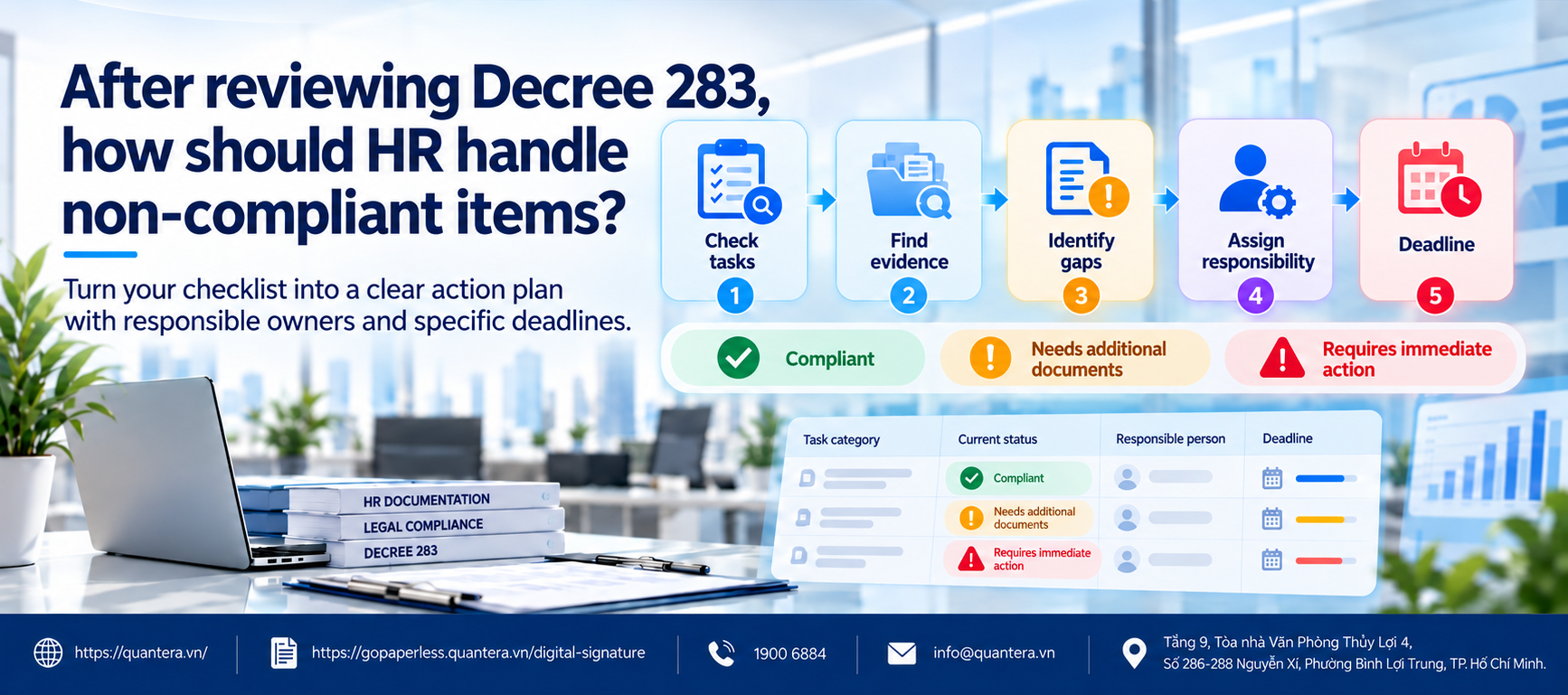
7. After Reviewing Decree 283, How Should HR Handle Non-Compliant Items?
A checklist is only valuable if, after the review, HR knows what to do with the items that do not meet requirements.
The simplest approach is not to immediately divide the issues into dozens of legal errors. Create a management table for each work item, its current status, available records, missing points, responsible person, and handling deadline.
For example, for labor reporting, the status may be “completed,” but proof of submission cannot be found. For internal labor regulations, the business has a file but has not confirmed whether it is the currently effective version.
For employment contracts, a group of contracts expiring within 30 days has no assigned owner. For social insurance, three new employees do not yet appear on the participation list.
HR can then classify items into three groups: compliant with sufficient evidence; completed but records/evidence are incomplete; and showing signs of non-compliance or already overdue.
The third group should be prioritized first, especially for issues that continue to arise daily, such as social insurance, expiring employment contracts, reports with deadlines, or records relating to employees who are currently working.
The important point is not to mark an item “Done” merely because HR remembers having performed it. Ask one more question: “If we had to present it tomorrow, which document would prove that it was done?”
This is the biggest change HR should make after reading Decree 283.
A practical review table can be used as follows:
| Work item | Current status | Available records/evidence | Missing point | Owner | Deadline |
|---|---|---|---|---|---|
| Employee management book | In progress | HR data file | 5 new employees not yet updated | HR Ops | 2 days |
| Labor report | Not yet due | 2026 data | Standardize before 05/12 | HR Manager | 30/11 |
| Employment contracts | Under review | Employment contracts + appendices | 8 contracts approaching expiry | HRBP | 7 days |
| Internal labor regulations | Available | PDF file | Confirm effective version | HR Legal | 5 days |
| Social insurance | Needs reconciliation | Social insurance list | 3 cases still missing | C&B | 2 days |
8. How Does GoPaperless Help HR Manage Employment Contracts and Supporting Evidence?
Decree 283 does not require businesses to use GoPaperless or any specific software. Technology also cannot decide by itself whether an employment contract is correct, whether a salary is appropriate, or whether the business has paid social insurance for the correct participants.
The value of technology lies in helping HR reduce errors caused by manual management.
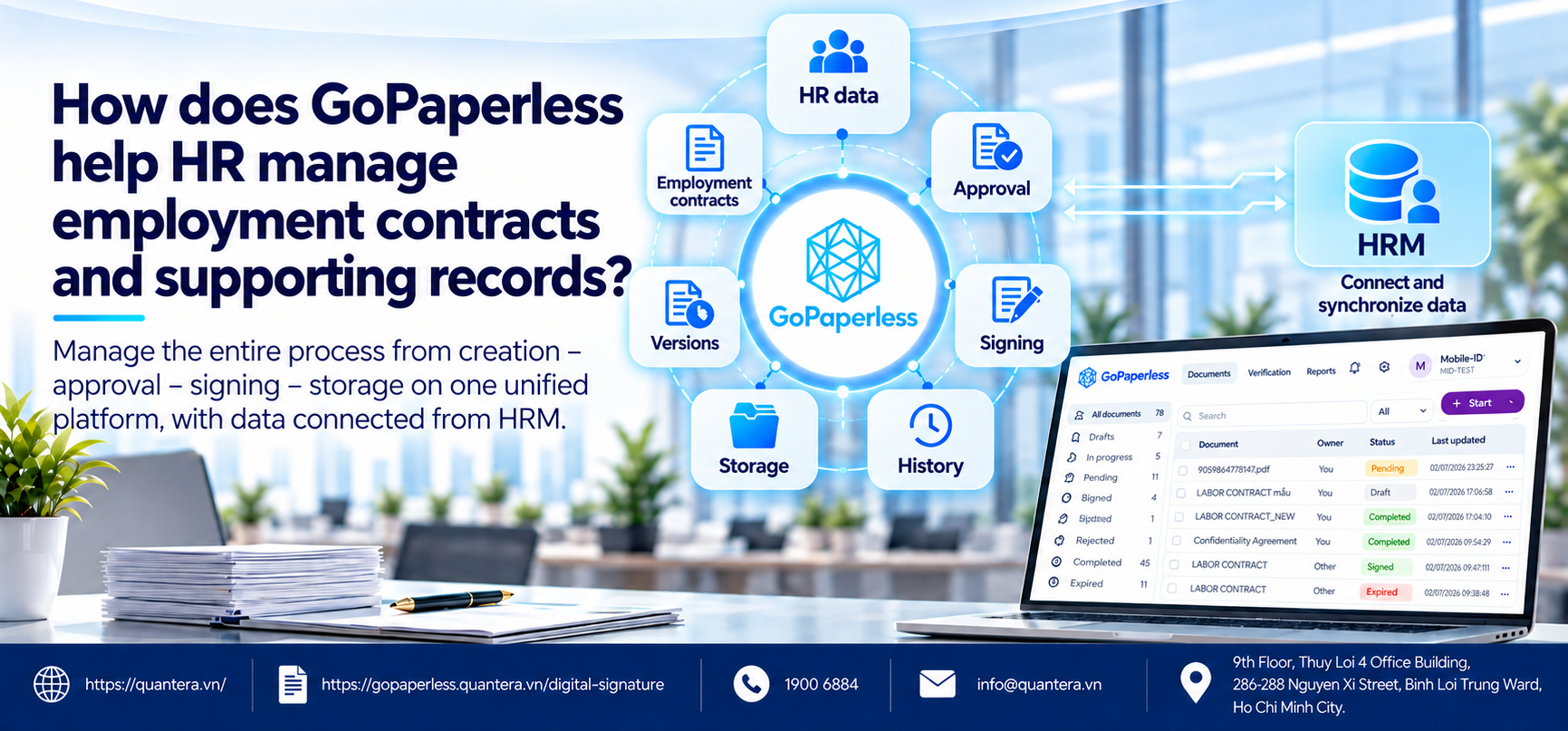
For employment contracts, one major issue is that data and records are often scattered. Employee information is in the HRM, the contract template is in a folder, the version awaiting approval is in email, the signed version is on the HR employee’s computer, and Excel is used to track expiry dates.
In that situation, HR finds it difficult to quickly answer seemingly simple questions: Which contract is currently effective? Who approved it? Which version is final? Which contracts are nearing expiry? Which document recorded a change during employment?
GoPaperless from Quantera helps businesses manage the creation, approval, execution, status tracking, and storage of electronic records in a unified workflow. For electronic employment contracts, the system can also manage identity, signatures, timestamps, transaction evidence, and the record lifecycle.
If employee data already exists in the HRM or ERP, GoPaperless can connect to reuse that data instead of requiring HR to re-enter it when creating an employment contract. When a record must pass through multiple reviewers and approvers, the system helps manage the workflow, status, and current responsible person.
For multi-version records, GoPaperless helps manage the record by lifecycle so HR can identify which version is being processed, which has been completed, and where the change history is stored. After execution, status and transaction history are stored centrally, making it easier for HR to retrieve them for reconciliation instead of searching through email or personal folders.
This is particularly useful in the context of Decree 283 because the system does not perform legal obligations on HR’s behalf, but it can help HR know where each record is, who handled it, which version is effective, and where the transaction history is stored.
For electronic employment contracts, businesses also need to consider the separate legal framework under Decree No. 337/2025/ND-CP and Circular No. 08/2026/TT-BNV. Therefore, if the objective is not only record management but also execution of electronic employment contracts, HR should assess both the operational requirements and the legal requirements of the electronic form.
Quantera recommends that businesses should not start with the question “Which software should we buy?”, but instead identify: Which work items are most likely to be missed? Which records are difficult to find? Which data is not being managed end-to-end?
Only then should the business decide which parts should be standardized through process design and which parts require technology support.
9. Conclusion
Decree No. 283/2026/ND-CP does not require HR to perform a completely unfamiliar set of tasks. Most areas that can give rise to violations are already part of the work businesses perform every day: managing employee lists, signing employment contracts, issuing internal labor regulations, paying wages, and participating in social insurance.
The problem is that there is a significant gap between “we still do this” and “we are doing this correctly and have sufficient records to prove it.”
An Excel file containing all employee names is not necessarily a complete employee management book. A folder containing hundreds of contracts does not necessarily mean HR knows which version is effective. Internal labor regulations sent by email do not automatically prove that all requirements for issuance and application have been satisfied. A payroll list also does not by itself prove that the business has registered and paid social insurance correctly for all employees who are required to participate.
Therefore, now that Decree 283 has taken effect, the most effective review method is not to sit down and reread each penalty amount. Start from each work item HR is managing and answer three questions:
Has the business performed this correctly? Which record proves it? If something is missing, who must handle it and by what date?
If HR can answer those three questions for workforce management, employment contracts, internal labor regulations, wages, and social insurance, the business already has a much stronger foundation for proactively controlling risk.
Is HR reviewing employment contracts, the employee management book, social insurance, or HR records after Decree No. 283/2026/ND-CP took effect but unsure where to start?
👉 Join the Zalo Group Q&A – Human Resources, Labor and Payroll Community to discuss real cases with the community and the Quantera team regarding workforce records, electronic employment contracts, social insurance, and HR process digitization.
10. Frequently Asked Questions about Decree No. 283/2026/ND-CP
When did Decree No. 283/2026/ND-CP take effect?
Decree No. 283/2026/ND-CP was issued on July 15, 2026 and took effect on September 10, 2026. From its effective date, the Decree replaces Decree No. 12/2022/ND-CP on administrative penalties in the fields of labor, social insurance, and Vietnamese workers working abroad under contracts.
Can a business be penalized for failing to report changes in labor use?
Yes. Decree 283 provides penalties for failure to report changes in labor use as required. HR should therefore check the reporting schedule and retain evidence that the report was submitted.
Is a business required to maintain an employee management book?
Yes. Employers are responsible for creating, updating, and managing the employee management book in paper or electronic form. Decree 283 penalizes failure to create the book, late creation, failure to ensure the required contents, or failure to fully update information as required.
Must a business with fewer than 10 employees have written internal labor regulations?
Decree 283 provides penalties for not having written internal labor regulations when employing 10 or more employees. For businesses below this threshold, HR must still comply with labor discipline rules and related obligations, but the requirement for written internal labor regulations should be determined based on workforce size and the Labor Code.
Can a business be penalized for failing to register all employees who are subject to compulsory social insurance?
Yes. Decree 283 separately regulates violations involving failure to register, or incomplete registration of, people who are required to participate in compulsory social insurance, while also distinguishing late payment and evasion according to the specific conditions.
Where should HR start when reviewing Decree 283?
Start with the data that already exists instead of rereading the entire document. Take the current employee list, then reconcile it against the employee management book, employment contracts, internal regulation/discipline records, payroll, and social insurance. Any point where data does not match or supporting evidence cannot be found should be placed on the priority remediation list.
See 36 more frequently asked questions and answers about electronic employment contracts and GoPaperless to learn more about legal requirements, operations, data, and implementation options.




Community Discussion